


Gemini Nano 4: How Google Will Enhance the AI of Your Future Smartphone
Google is not just promising AI on smartphones; it is already laying the groundwork for deployment. With a new Developer Preview of AI Core and the introduction of Gemma 4 as the technical foundation, the company sends a clear message to developers: start building now, your apps will be ready when the first devices compatible with Gemini Nano 4 are launched later this year.
A Transition Designed With Developers in Mind
Google clarifies that code written today with Gemma 4 under the new AI Core Developer Preview will be forward-compatible with future devices powered by Gemini Nano 4. In other words, the company has yet to roll out the new generation of Nano to the public, but it is already opening the access ramp for developers.
This strategy is crucial as it addresses a long-standing issue in on-device AI: waiting for the final hardware before starting development. Google aims for apps to be ready by the time the new smartphones are launched, rather than months later.
Gemma 4 Becomes the Foundation for Gemini Nano 4
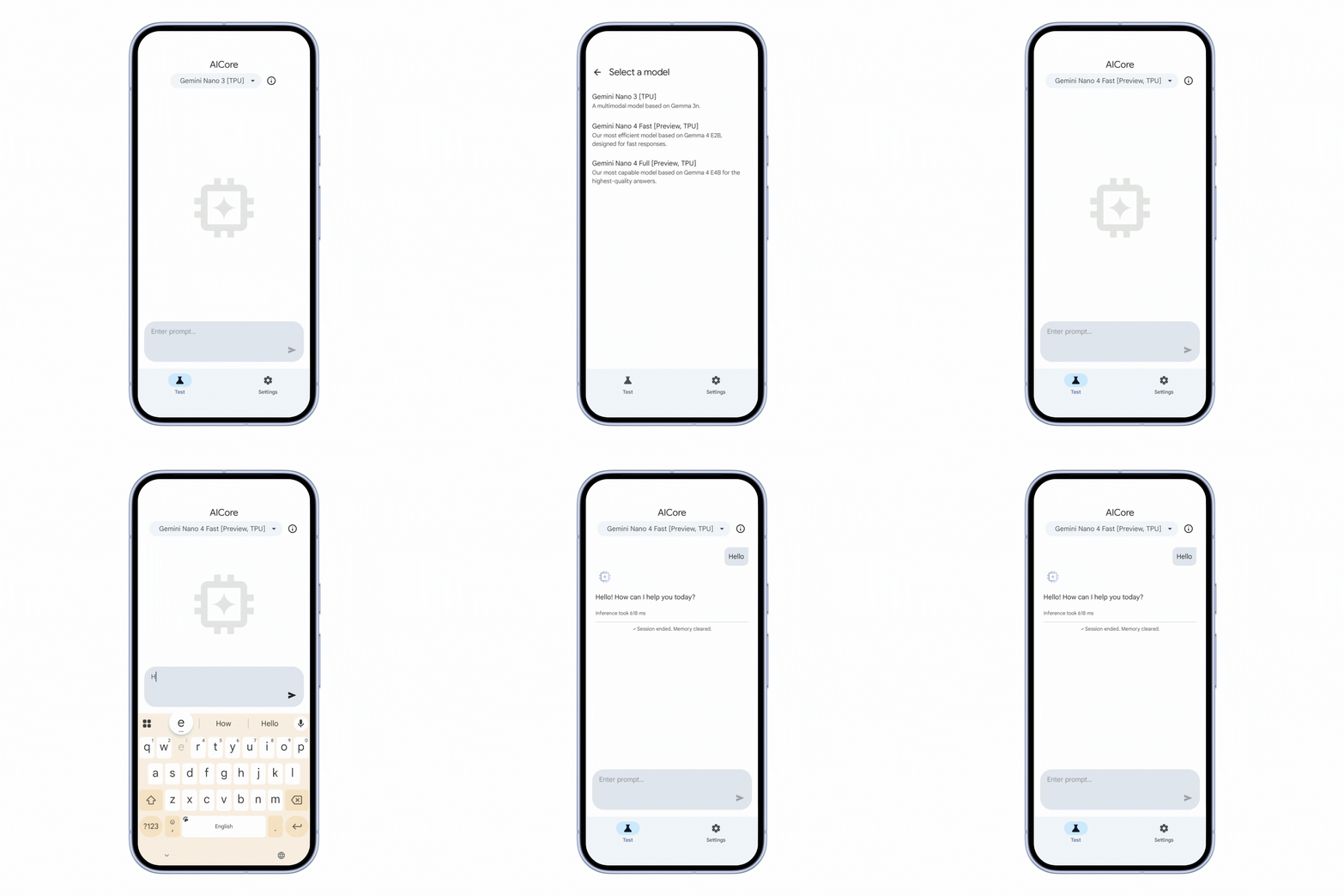
Google has confirmed that Gemma 4 serves as the foundational model for the next generation of Gemini Nano, known as Gemini Nano 4. Two variants are highlighted in the Android preview: a lighter version focused on speed and latency, and a more robust one for higher quality responses and handling complex tasks.
Gemini Nano 4 Fast will be based on Gemma 4 E2B, while Gemini Nano 4 Full is based on Gemma 4 E4B.
Google also points out that this new foundation is up to four times faster than the previous generation and can use up to 60% less battery on Android. These figures are likely the most significant from the announcement as they directly address the limitations of local AI on smartphones: latency, overheating, and battery life.
Why This Matters for Future Android Flagships
The crux of the issue is clear: Google increasingly advocates for AI on smartphones to run locally, without relying on the cloud. This approach offers three benefits: faster responses, greater privacy, and improved availability even offline. The Google developer blog post specifically presents Gemma 4 as a model designed for agentic and multimodal experiences at the edge, meaning directly on the device.
This shift will also change how Android flagships differentiate themselves. If local AI functions become central, the quality of the experience will increasingly rely on the interplay between models, software integration, and hardware accelerators. Google explicitly mentions collaborating with the Android ecosystem on AI Core, while the broader rollout of Gemma 4 emphasizes optimizations for mobile devices, edge devices, and partner chips.
More Multimodal, More International, More “Agentic”
Gemma 4 is not just a performance upgrade. Google also markets it as a more robust model for reasoning, coding, vision, and agentic workflows, now supporting over 140 languages. The model also accommodates multimodal uses that combine text, images, and audio, opening the door to richer assistants, local transcription, contextual translation, and embedded visual experiences.
On Android, this implies that future “intelligent” features will no longer be isolated gimmicks but potentially a cross-cutting layer of the system. This conclusion is analytical but aligns with the foundational role attributed to Gemini Nano across multiple generations and further reinforced by Gemini Nano 4.
However, several ambiguities remain. Google has not yet published an official list of compatible smartphones or provided an exact launch date beyond an expected timeline later in 2026. The company has also not detailed the commercial segmentation on a device-by-device basis. In practice, the quality of experience will also depend on support for AI Core and onboard accelerators.
This is crucial, as not all Android smartphones will automatically benefit from the same level of performance. The software framework is being established, but the real hierarchy will also depend on the silicon. This final point is analytical in nature.
Google Is Establishing a Standard Rather Than Just a Feature
The true significance of this announcement may lie in this aspect. Google is not simply launching a “new little AI model.” It is creating a standardized pipeline between its open models Gemma, its developer environment AI Core, and the future Android devices equipped with Gemini Nano 4. This architecture reduces friction between experimentation, prototyping, and real-world deployment.
In straightforward terms, the upcoming competition among Android flagships will not only focus on camera quality or raw power. It will also hinge on a much more fundamental question: how well will your phone manage to run practical, local, and fast AI daily? And Google clearly wants to set the rules of the game even before the new devices arrive.



