

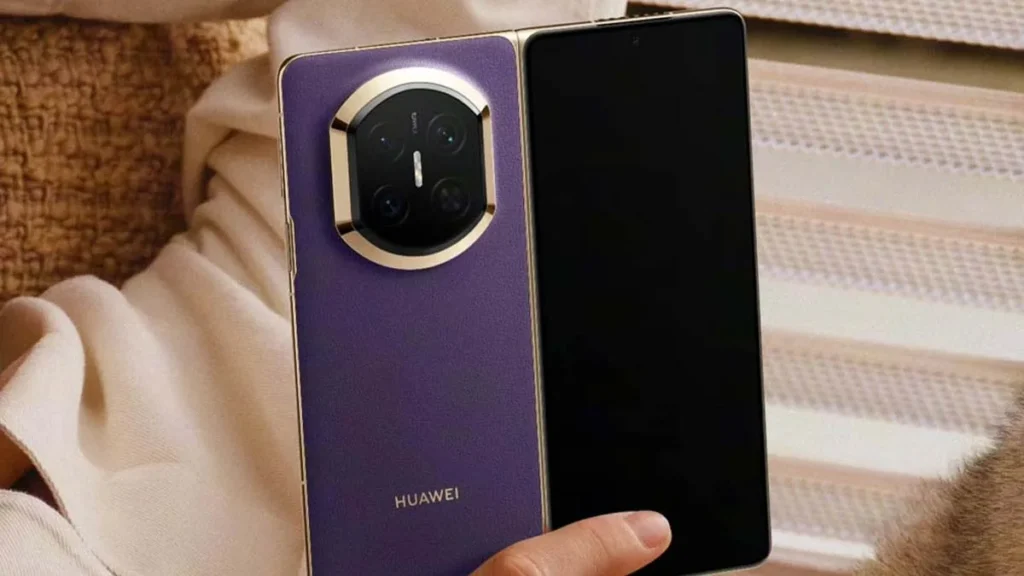
Huawei Mate X8: Leak Reveals Even Bigger Foldable Screen
Huawei has yet to make any official announcements, but initial leaks surrounding the Mate X8 suggest a clearly defined evolution. The highlights include a slightly larger form factor, a new in-house Kirin SoC, and a potential redesign of the camera module. This is not an anticipated revolution; rather, it represents a methodical refinement that aligns with the recent trajectory of the brand.
A Mate X8 That Gains Some Space, Inside and Out
According to a leak attributed to Digital Chat Station reported on April 2, the Huawei Mate X8 is expected to feature a 6.5-inch external screen and an 8.15-inch foldable internal display. This represents a modest yet tangible progression compared to the Mate X7, which was launched in late November 2025 with an 8-inch main screen and a 6.49-inch external screen.

This slight increase in dimensions tells a classic story in the premium foldable market: manufacturers are no longer focused solely on impressing, but on optimizing user comfort through small adjustments. Adding a tenth of an inch here, a few millimeters there, shifts the focus from spectacle to ergonomics.
This is especially true for Huawei, which has been fine-tuning its interpretation of the “book-style” format over several generations.
A Main Sensor of 50 Megapixels, with a Focus on Camera Design
On the imaging front, the leak mentions a main sensor of 50 megapixels with a 1/1.3-inch format, along with an “ultra-thin” camera module. Taken alone, this is not a groundbreaking change. However, in the world of foldables, the thickness of the camera module remains a major topic: it directly affects hand balance, product elegance, and the compact feel when closed.
This point aligns with earlier rumors regarding a radically redesigned Mate X8 camera. As early as November 2025, several leaks indicated a device with 20GB of RAM in certain versions and a significant redesign of the camera module, with various design avenues still under consideration.
In other words, Huawei is not solely focused on specifications but is also working on visually aligning its foldable device. And in this segment, where every millimeter counts, design can weigh as heavily as a sensor upgrade. This viewpoint is inferred, based on the current leak regarding the thinner module and previous rumors of a redesign.
Kirin 9040: The Next Step in In-House Silicon
Under the hood, the Mate X8 is expected to be powered by a Kirin 9040 chip, set to succeed the Kirin 9030 Pro used in the Mate X7. The latter was already featured in the foldable launched in November 2025.
This topic is strategic for Huawei, which continues to invest in its in-house silicon, not only for performance reasons but also for technological sovereignty and vertical integration. However, caution is warranted: nothing in the available sources allows us to confidently assert that the Kirin 9040 will compete directly with the best Qualcomm or MediaTek chips in raw power. The progress seems credible; however, achieving parity remains to be proven.
HarmonyOS 7 and the Question of 20GB of RAM
Several rumors also link the Mate X8 to HarmonyOS 7. However, this requires caution: recent reports have indeed mentioned a possible release of HarmonyOS 7 in June 2026, but this timeline has not been officially confirmed.
Similar caution applies regarding the RAM. The figure of 20GB has been circulating since late 2025, but given that the Mate X7 already existed in a Collector’s edition with 20GB of RAM according to the specifications released during its launch, it wouldn’t be completely unreasonable. That said, there remains a gap between a possible configuration and an actual configuration that is carried over.
Huawei Seems to Want to Polish Its Formula Rather Than Overturn It
At this stage, the Mate X8 feels less like a disruptive gamble and more like a targeted evolution of the Mate X7: a little more screen, a new Kirin, a revamped camera module, possibly more memory, and a tighter software-hardware integration. This makes logical sense for Huawei, aiming to consolidate its position in the premium foldable segment without dismantling a already mature formula.
Ultimately, the most intriguing aspect is that Huawei continues to treat the foldable not merely as a flagship product, but as a showcase of its capability to exert greater control over its technological stack—design, chips, software, and imaging. This may be where the Mate X8 finds its true significance, far beyond simply being another annual foldable release.



