

Goodbye Chaos? Gmail Launches AI Inbox to Sort Your Emails for You
The promise of Inbox Zero has always held a somewhat mythical quality. In reality, the email inbox is a daily stack of newsletters, reminders, purchase confirmations, important messages, and urgent emails buried in the flow. With AI Inbox, Google aims to fundamentally change this dynamic by transforming Gmail into a prioritization space rather than just a chronological list.
The feature, announced in January 2026 during the redesign “Gmail Enters the Gemini Era,” is now beginning to appear in beta for select Google AI Ultra subscribers.
This is not merely a visual gimmick. AI Inbox redefines what an email inbox should be in 2026: no longer a raw feed to scroll through manually, but a synthesized, prioritized view powered by AI, designed to alleviate mental load even before the first message is opened.
A new view in Gmail designed to sort for you
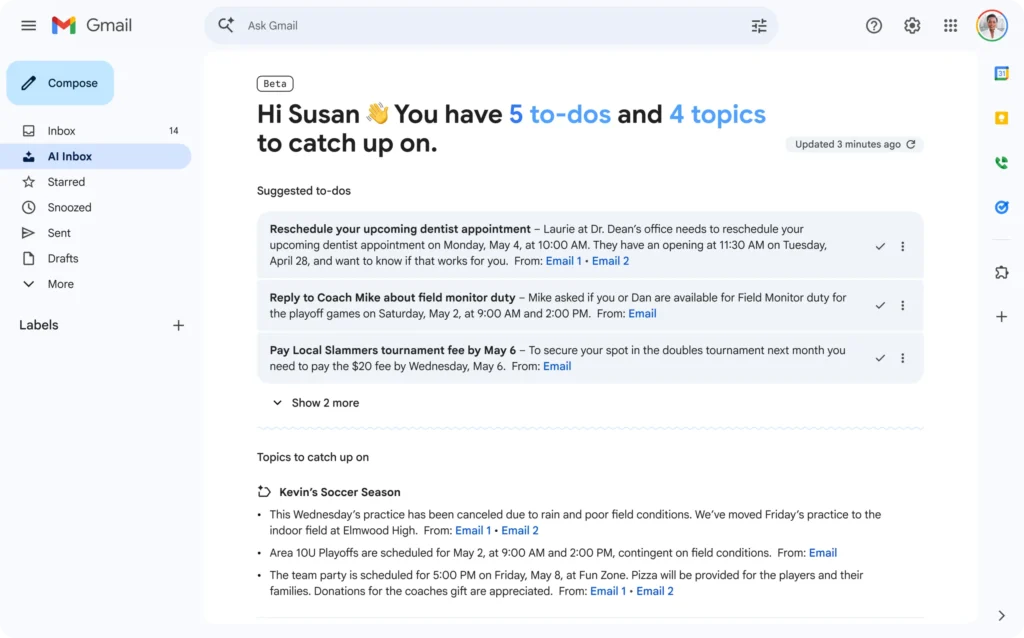
In its official presentation in January, Google explained that AI Inbox filters out the noise to highlight important emails, using a personalized briefing logic.
The feature emphasizes two central ideas: actions to take and information to catch up on, preventing users from having to scan their entire inbox to reconstruct priorities themselves. Google also notes that AI Inbox relies on signals such as the people you interact with most, those in your contacts, and relationships it can infer from message content.
In other words, Gmail is gradually moving away from being neutral in email presentation. The app no longer just displays; it starts to interpret. And this shift is precisely what makes AI Inbox intriguing.
A feature initially reserved for premium users
Google initially did not make AI Inbox available to all upon its announcement. In January, the company stated that access would be granted to trusted testers before a wider deployment “in the coming months.”
This rollout is now starting to materialize. According to 9to5Google, Google has launched the beta of AI Inbox for Google AI Ultra subscribers, the highest tier of its AI offerings. This plan is available in France for €274.99 per month.
However, Google has yet to publicly provide a detailed timeline for other plans. The company merely indicated in January that the feature would become more widely available in the coming months.
Gmail shifts from an inbox logic to a personal assistant logic
The significance of AI Inbox goes beyond mere visual organization. In January, Google had already positioned Gmail as a proactive assistant, introducing AI Previews, Writing Assistance, Suggestion Responses, and Proofreading, several of which are powered by Gemini 3.
AI Inbox takes this logic further. While AI Previews assist in understanding a thread or asking the inbox a question, AI Inbox directly reorganizes Gmail’s entry surface. It’s not just AI responding to your queries; it’s the interface itself that changes to reflect what AI deems priority.
Privacy remains the central point of tension
Google is well aware that this type of functionality raises an immediate question: what happens to email content when AI begins reading, connecting, and prioritizing it? On this point, Google reiterates that privacy protections remain in place. In its January Gmail announcement, the company stated that AI Inbox analysis is done “securely,” and that users maintain control over their data.
However, it’s important to note a significant nuance: for AI Inbox to function, it must analyze the content of emails. The distinction highlighted by Google is that this analysis is used to provide the functionality, without automatically turning your emails into open training data for its models.
A quiet revolution for Gmail
What Google is attempting here is more ambitious than mere smart sorting. The company is tackling the very form of email, which has remained remarkably stable for years: a pile of messages that users must manually sift through, classify, open, and interpret. With AI Inbox, Gmail begins to function as a personalized daily briefing, almost like a decision-making dashboard.
This may not appeal to everyone. Some may still prefer the neutrality of a chronological list. Others might find this new view a welcome cognitive relief. But one thing is already clear: Google no longer wants Gmail to be just a messaging service. It aims for Gmail to become an intelligent filter between you and the digital noise.
And if AI Inbox lives up to its promises, the inbox could cease to be a place to manage and become, at long last, a space that works for you.



