

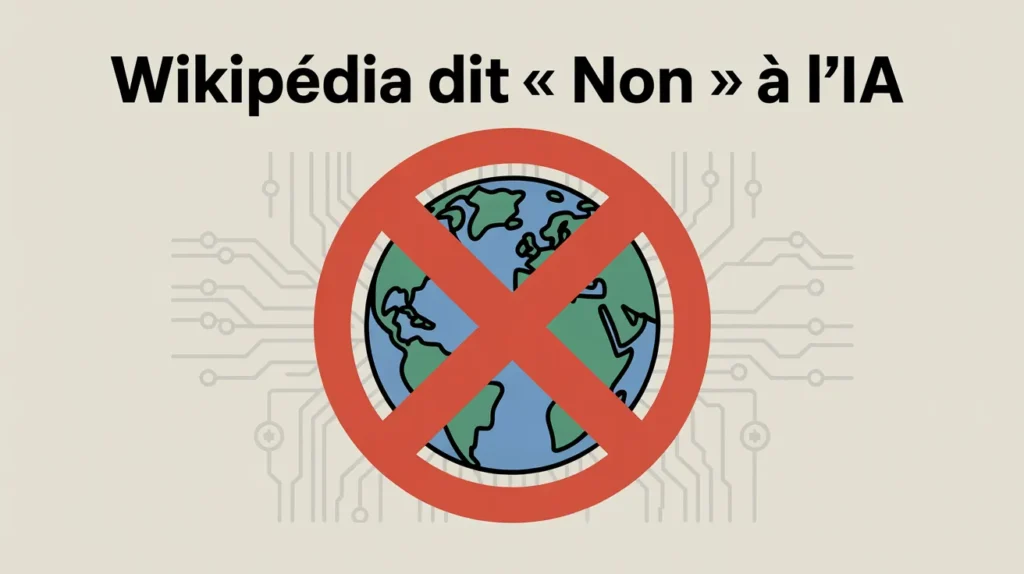
Wikipédia dit « Non » à l’IA : L’encyclopédie interdit la rédaction par les LLM
In response to the rise of generative artificial intelligence, Wikipedia is exercising caution. The world’s most consulted collaborative encyclopedia has made a strong decision: to prohibit the use of language models (LLMs) for writing or rewriting its articles.
This position reflects both the technical challenges of AI and the historical demands for reliability within the project.
Wikipedia: A Decision Born from a Long Community Debate
For several months, the Wikimedia Foundation community—responsible for overseeing Wikipedia—has been working to establish clear guidelines around the use of generative AIs. The shared realization was that models like ChatGPT or other LLMs can produce fluid text, but not necessarily reliable or sourced content.
As explained by the administrator known as Chaotic Enby, previous attempts at regulation had failed, being deemed either too vague or overly restrictive. This time, the community reached a consensus: to strictly regulate AI use without completely hindering its usefulness.
The new rule is unambiguous: contributors may no longer use LLMs to directly generate or rewrite encyclopedic content.
However, two exceptions remain:
- Writing Assistance: AIs can be used as tools for stylistic enhancement—similar to an advanced spelling and grammar checker. But with one essential condition: each modification must be manually verified with sources. The identified risk is clear: LLMs can subtly alter the meaning of a text or introduce unsourced information.
- Assisted Translation: The second allowed case is translation. Contributors may use AI to produce an initial version of a text in another language. However, human oversight is still crucial: the editor must be proficient in both languages to correct errors and ensure fidelity to the original content.
A Local Policy with Global Implications
Notably, this decision currently only affects the English version of Wikipedia (en.wikipedia.org). Each language version maintains its autonomy. Some communities, such as Spanish Wikipedia, go even further by outright prohibiting the use of LLMs for creating or enriching articles, without notable exceptions.
This fragmentation illustrates a lesser-known reality: Wikipedia is not a monolithic entity but a decentralized ecosystem where each community experiments with its own rules in response to AI.
The Major Challenge: Detecting AI… Without Mistakes
A lingering question remains: how to identify AI-generated content? Today, detection tools are still imperfect. Wikipedia acknowledges that some human writing styles might resemble those produced by LLMs—making any automated moderation risky.
The consequence is that, despite the ban, AI-generated content could continue to appear, especially on less-monitored pages. This decision is not merely technical; it is deeply philosophical. Since its inception, Wikipedia has relied on three pillars: verifiability, neutrality, and human contribution.
By limiting the use of generative AIs, the platform asserts that knowledge cannot be blindly delegated to probabilistic systems, no matter how capable they are. In a context where AI is redefining large-scale content production, Wikipedia chooses a distinctive path: one of enhanced human oversight.
Toward a Regulated Coexistence Between Humans and AIs
Instead of a complete rejection, this new policy signifies an attempt to strike a balance. AI is embraced as a tool—but rejected as an author. This subtle yet essential distinction might inspire other editorial platforms facing similar challenges.
Ultimately, the question extends beyond Wikipedia: in a world saturated with generated content, the value of information will increasingly depend on its traceability, verification… and the human responsibility that accompanies it.



