

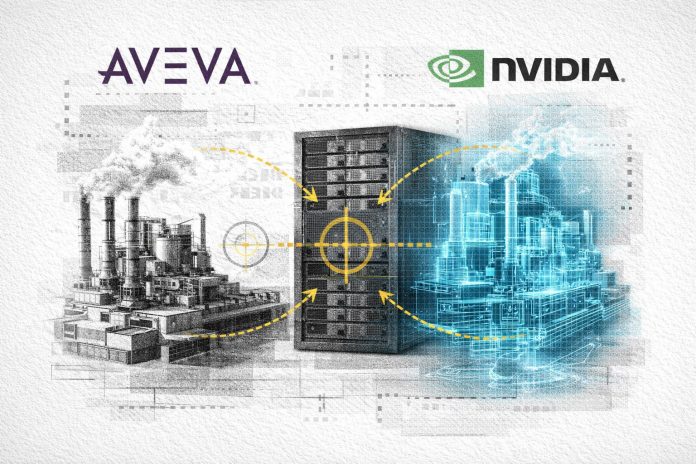
Next-generation AI factories demand vast amounts of electricity, consuming multiple gigawatts and relying on thousands of GPU servers. The design, construction, and operation of these facilities far exceed the capabilities of traditional industrial project management tools. In response to this paradigm shift, Aveva is integrating its complete software portfolio into the NVIDIA Omniverse DSX Blueprint, positioning the digital twin as the central nervous system of these infrastructure lifecycles.
AI factories necessitate full-scale management akin to industrial engineering, procurement, and construction projects, utilizing the simulation methods, tools, and data chains characteristic of major heavy industry projects. Aveva brings significant industry legitimacy to the table, with over 90% of large industrial companies worldwide relying on its solutions. The company has developed industrial digital twin expertise through decades of deployments in energy, chemistry, and critical infrastructure. Joining Schneider Electric and ETAP as a strategic partner in the Omniverse DSX Blueprint, Aveva completes an ecosystem of design-simulation-operation that NVIDIA aims to establish as the standard for hyperscalers and neoclouds heavily investing in AI computing capabilities.
“AI factories are rapidly becoming industrial powerhouses for the global digital economy. To support this transformation, Aveva and NVIDIA are creating a new approach to deploying digital twins, grounded in business expertise, innovative software, and operational excellence,” said Rob McGreevy, Chief Product Officer at Aveva.
Reuse to Accelerate
The first level of integration focuses on the design phase. A new converter enables clients to import OpenUSD SimReady assets into Aveva Unified Engineering, allowing them to reuse existing assets, design new ones, and utilize high-fidelity data and environments built on NVIDIA Omniverse libraries. This interoperability between SimReady formats and Aveva’s engineering tools alleviates digital chain friction between virtual design and physical execution, a chronic pain point in large data center projects.
Aveva Asset Information Management complements this setup by offering a centralized data source to manage equipment and systems throughout their lifecycle—from design to operation—with guaranteed consistency during modifications. For teams constructing AI factories that span tens of thousands of square meters, the ability to trace every configuration change from design through to maintenance represents a direct operational advantage, enhancing both asset reliability and regulatory compliance.
Liquid Cooling Simulation and IT/OT Convergence
High-density AI factories present two specific technical challenges inadequately addressed by generic tools: thermal management of GPU racks and the convergence of operational data from diverse domains. Aveva Process Simulation addresses the first challenge by enabling advanced liquid cooling network modeling and simulation, optimizing designs to maximize cooling efficiency before the first cable is laid. For infrastructures where energy density per rack can reach several tens of kilowatts, pre-simulation is not a luxury—it is a prerequisite for profitability.
For the second challenge, Aveva’s PI System aggregates IT and OT data within NVIDIA Omniverse DSX Exchange, creating a unified flow from technical building management systems, electrical distribution systems, cooling systems, and GPU server workloads. This convergence is essential for achieving genuinely predictive supervision: the upcoming integration of NVIDIA’s NV-Tesseract model will enhance this aggregated telemetry’s anomaly detection and forecasting capabilities, enabling operators to anticipate performance degradation before it impacts inference workloads.
Unified Oversight of Electrical, Mechanical, and Safety Systems
Aveva Operations Control and Unified Operations Center form the operational oversight layer of the architecture. They allow for centralized management of three critical dimensions within a data center’s infrastructure: electrical infrastructure (uninterruptible power supply, switchgear, power distribution units, generators), mechanical infrastructure (coolers, fluid distribution units), and safety systems. This convergence on a single platform addresses a frequent operational dysfunction in large data centers: the fragmentation of oversight tools by technical domain, which delays incident root cause identification and corrective interventions.
Vladimir Troy, Vice President of AI Infrastructure at NVIDIA, highlights the significance of this collaboration: “The rapid rise of gigawatt-consuming AI factories necessitates a new class of industrial intelligence to optimize the entire lifecycle of these massive data centers—from initial design to real-time operation. By integrating Aveva’s engineering and simulation software with the NVIDIA Omniverse DSX Blueprint, we’re providing developers with a unified digital twin architecture to accelerate the deployment and efficiency of the world’s most advanced AI infrastructures.”
For businesses and infrastructure managers observing the dynamics surrounding AI factories, the Aveva-NVIDIA partnership signals a profound industrial convergence: the methods and tools of heavy industrial engineering—such as simulation, asset lifecycle management, and IT/OT convergence—are transitioning to hyperscale data centers. This convergence reflects a reality that manufacturers and operators of these infrastructures are now measuring on a gigawatt scale, as operationally, an AI factory aligns more closely with a refinery or power plant than with a traditional data center.



