

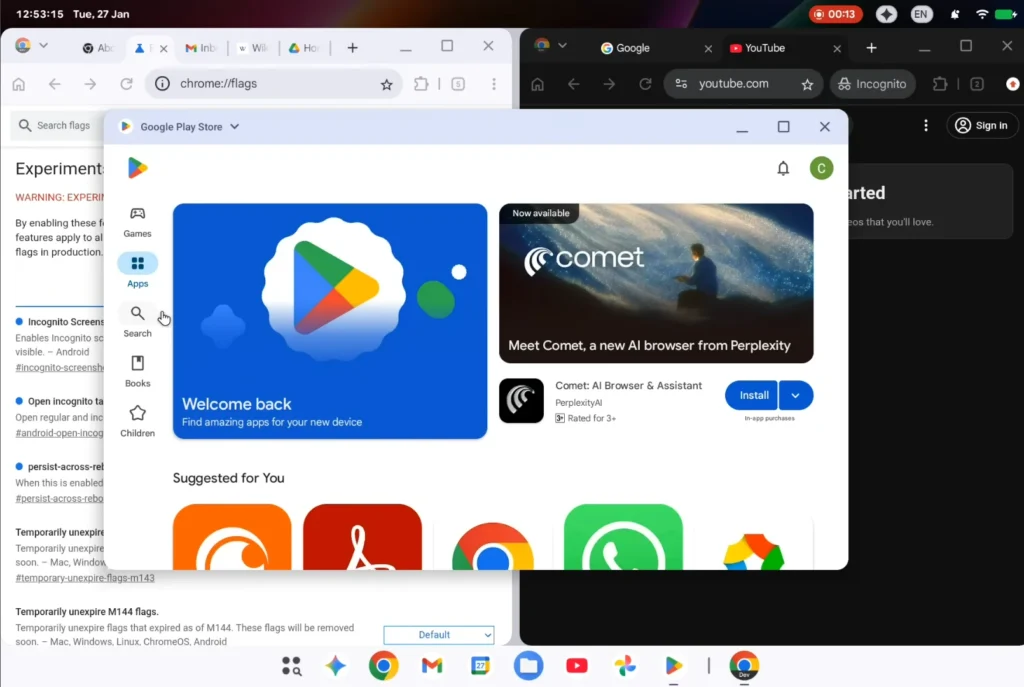
Aluminium OS: Google plans historic merger between Android and ChromeOS
For years, Google has operated two parallel platforms: Android for smartphones and tablets, and ChromeOS for laptops. This separation is becoming increasingly difficult to justify as ecosystems strive for fluidity, coherence, and AI integration.
Now, this convergence seems to be entering a much more concrete phase: Google has confirmed its desire to merge ChromeOS and Android, and recent statements from Sameer Samat, president of the Android ecosystem, suggest that a significant milestone involving Aluminium OS could be achieved later in 2026.
What Is Aluminium OS?
According to information circulating for several months, Aluminium OS will be a laptop-oriented platform built on Android, designed to unify mobile and desktop usage. The aim is not just to run Android applications on larger screens but to provide a much more comprehensive experience, featuring desktop-level multitasking, improved app integration, continuity across devices, and a deeper AI layer via Gemini.
In other terms, Google is not seeking to merely juxtapose two systems but to create a unique platform capable of powering phones, tablets, and laptops with a more cohesive approach.
This project could be pivotal in the competition with Apple and, to a lesser extent, with Windows in the personal computing space. This interpretation arises from the positioning described by various sources.
Why Does This Evolution Matter?
For users, the implications go beyond just the name of the system. A more integrated fusion of Android and ChromeOS could facilitate better continuity between smartphones and PCs, provide more seamless access to Android applications on laptops, and deliver a more unified experience on larger screens.
Google has already been steering Android in this direction with more desktop features and efforts on large displays, making this transition more credible than before.
This is also a strategic movement for Google. While Apple effectively connects iPhone, iPad, and Mac in a clearly defined ecosystem, Google has had a more fragmented narrative until now. Aluminium OS could be the missing link among mobility, productivity, and personal AI. This conclusion is an inference based on the convergence confirmed by Google and the nature of the project described by the sources.
Google executive Sameer Samat confirms that Aluminium OS is on track for a release later this year to power a new generation of premium Android laptops. https://t.co/AvL6X2On89
— Chrome Unboxed (@chromeunboxed) March 16, 2026
A Launch in 2026, But Probably Not for Everyone Right Away
However, it’s important to remain cautious regarding the timeline. Sameer Samat stated he is “super excited about later this year” when questioned about Aluminium OS at MWC 2026, fueling the idea of a public milestone in 2026.
That said, there is currently no confirmation that this will be a massive public rollout this fall. Most credible sources suggest instead that there will be an initial official moment—demonstration, initial builds, opening to partners or developers—rather than an immediate and complete replacement of ChromeOS.
Additionally, Google has not indicated any plans for the immediate discontinuation of ChromeOS. Android Authority reports rather on a dual strategy, where ChromeOS would continue to exist, at least for a transition period.
More Than Just a New OS, A Shift in Direction
Ultimately, Aluminium OS represents something broader regarding Google’s evolution. The company aims not only to enhance Android or prolong ChromeOS; it seeks to redefine its position in personal computing, at a time when AI is reshaping how we work, create, and navigate across devices.
If Google successfully manages this transition, Aluminium OS could become much more than a new operating system. It could be the group’s most serious attempt to transform Android into a true universal platform—spanning smartphones to laptops—and finally provide a credible answer to Apple’s tight integration and Windows’ longstanding dominance in the PC market.



