

MWC 2026: Tecno Reinvents Smartphone With Modular and Tri-Fold Concepts
At Mobile World Congress 2026 in Barcelona, Tecno showcased a straightforward yet powerful idea: built-in AI demands more power (and space) than modern smartphones can provide. Thus, the brand is exploring an alternative approach—adding features on demand rather than integrating everything into one device.
A Realization: AI is Stifled by Current Formats
Smartphones have slimmed down, camera modules have expanded, batteries have become more efficient, and generative AI comes with its own energy costs. Tecno introduced a series of concepts aimed at separating the “everyday” experience (a lightweight, slim, pleasant device) from the “intensive” experience (creation, gaming, capturing, computation).
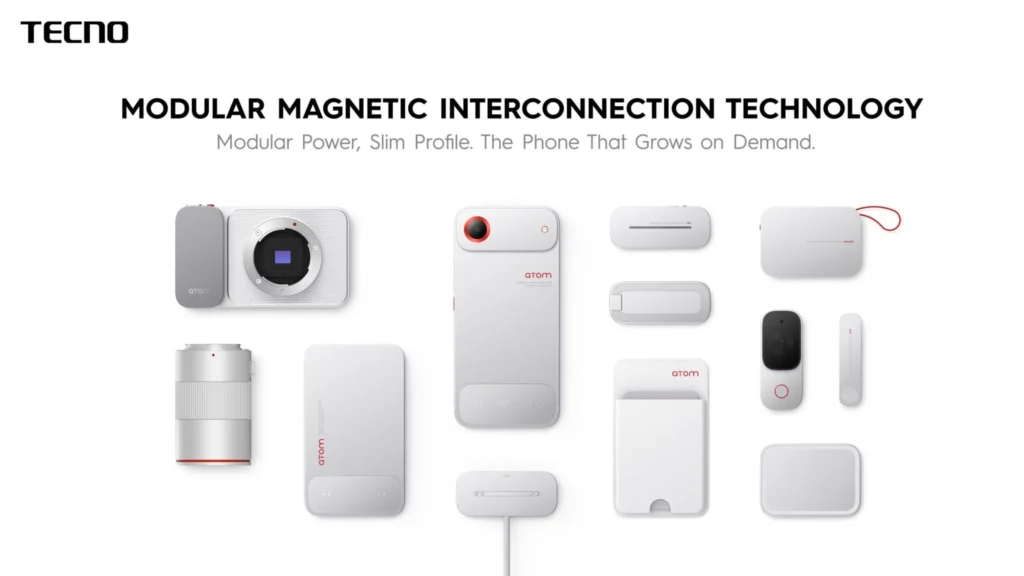
Modular Magnetic Interconnection: AI, in Premium LEGO Form

At the heart of this is the Modular Magnetic Interconnection Technology, an architecture that allows modules to be attached magnetically—stackable batteries, action cameras, telephoto lenses—with connectivity designed to be “smart” rather than just a passive accessory.
Two aesthetic interpretations reflect the same philosophy:
- ATOM Edition: clean lines, a “rational structure” mindset, silver aluminum with red accents.
- MODA Edition: a more demonstrative appearance, almost “geek couture.”
The goal is less about reviving the old dream of a modular smartphone and more about alleviating constraints: the phone remains slim, while “extra” capabilities can be added when needed.
POVA: An Ecosystem Designed for Gamers (and Performance)

Tecno further explores this logic with the POVA Ecosystem, a proposal focused on gaming and “visible hardware” culture. Highlights include:
- POVA Metal, touted as the first full metal unibody 5G smartphone featuring a Snapdragon processor—reintroducing the material at the forefront, countering the plastic “gamer” trend.
- POVA Controller Slide, claimed to be the first controller offering “targeted” aiming for MOBAs with an adjustable viewing angle (0 to 25°) and wireless charging.
- POVA earbuds with futuristic designs, dot-matrix displays, and light signatures: a small detail, but consistent with this idea of an ecosystem that is both portable and playable.
Edge AI: When AI Operates Without the Cloud

Another strategic focus is the Edge-Side AIGC Preview Concept Technology, aiming to execute generative AI on-device without Internet connection, reducing latency and cloud dependence.
Tecno has collaborated with Arm to develop an optimized style transfer preview: less flickering and “fluctuation,” with real-time previews at 30 fps in split-screen mode. Simultaneously, the brand claims to have compressed its models to function offline while maintaining stable artistic quality.
Beyond the demo, there’s a clear message: the “AI phone” will not just be about features, but also about the pipeline (computation, memory, energy, heat, latency). In this realm, offloading hardware (modules) or optimizing local execution (edge) are two complementary solutions.
Other Concepts: A Showcase of Engineering and Identity Lab
The booth was also a playground for design:
- AI EINK, an electronic ink back covering that adjusts its shades via AI recognition from the camera, customizable through an app.
- TECNO Slim 2, ultra-thin with a 0.7 mm border.
- POVA Neon, featuring ionized inert gas lighting for a luminous effect.
- A Concept Design Suite (laptop, tablet, earbuds, smartwatch, glasses, external battery) themed “Music in Motion” with lemon-yellow and urban-gray colors.
The Showpiece: The Tri-Fold Phantom Ultimate G Fold
Tecno also highlighted its PHANTOM Ultimate G Fold Concept, touted as the thinnest tri-fold with a 9.94-inch screen that folds twice inward—a practical choice to protect the display when closed.

In terms of dimensions: 11.49 mm when folded and 3.49 mm when unfolded, featuring a 2,000 MPa steel hinge and a Titan Fiber back measuring 0.3 mm.
What Tecno Foresees
At its core, these concepts point to a shared ambition: to evolve the smartphone without turning it into a brick. The modular approach suggests a new hardware grammar (a “base” phone + extensions), while edge AI hints at a battle for optimization where performance will not just be measured in TOPS, but in actual fluidity and battery life.
The critical question remains: can these ideas cross the boundary between showroom display and viable, standardizable, and sustainable products? At MWC 2026, Tecno did not provide a commercial answer—but it established a direction: AI is no longer just an addition to smartphones; it compels them to evolve.



