

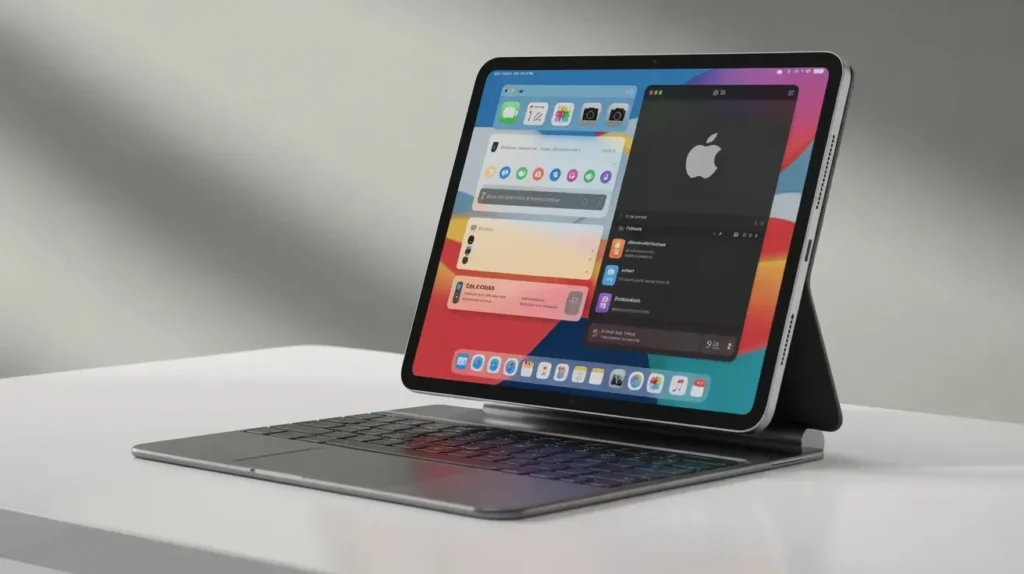
Why Does Apple Still Refuse to Create the iPad-Mac Hybrid in 2026?
For the past decade, Apple has repeatedly received the same request: “Give us a single device that combines the iPad and Mac.” However, the company continues to maintain a clear distinction between iPadOS and macOS.
According to recent reports by Mark Gurman from Bloomberg, this decision is deliberate: Apple believes that a “hybrid” product would actually harm its business more than help it by cannibalizing sales that currently complement each other.
Apple’s Logic: Avoiding Cannibalization and Selling Two Devices, Not One
The reasoning is cold yet coherent: if an iPad could fully run macOS (or if a Mac became fully touch-based like the iPad), it might become the only device some customers would buy. Apple prefers to create a “two-product” experience: an iPad for mobility/touch/light creation, and a Mac for “pro” production — both linked through Sidecar/Continuity.
This strategy also helps safeguard two very different revenue streams: the iPad as an accessory platform (Pencil, keyboards) and the Mac as a premium work machine (high margins, enterprise upgrades).
Adding Touch Features to the Mac Without Turning the iPad into a Mac
Currently, there’s an interesting development: Gurman describes a touchscreen MacBook Pro expected by the end of 2026, but with a conservative approach. It would be a “normal” Mac with added touch functionality, not a device that transitions to an iPad-like interface.
Several reports even mention the possibility of adapting the macOS interface to better accommodate touch (larger elements, contextual UI) while maintaining the keyboard/trackpad as the primary means of interaction.
What About the “Large Foldable” iPad? Apple Will Keep It on the iPadOS Side
Another frequently discussed concept is a very large foldable iPad (close to a laptop screen size when opened). Bloomberg previously described it as a future “iPad-like” device, not as a disguised Mac — specifically to avoid internal competition with the Mac lineup.
In short, Apple is open to expanding, folding, and refining… but not merging.
The iPad Pro Is Powerful, but the Software Remains “Leashed”
The irony is that the iPad Pro (and iPadOS 26) is progressing in multitasking and productivity but still has structural limitations: window management, pro workflows, file constraints, and application behaviors. Apple is making improvements, but not crossing the line into a “total laptop replacement” — as that path leads directly to the Mac.
If you’re waiting for a true iPad to replace a Mac, the short-term likelihood remains low. The most realistic compromise at Apple seems to be a touchscreen Mac (coming in late 2026) and a larger/flexible iPad that stays on iPadOS.
This leads to an ironic conclusion: Apple might offer the “hybrid experience” not through a single device… but with a more tactile Mac plus a larger/more versatile iPad, allowing both to stay in their respective categories.



