

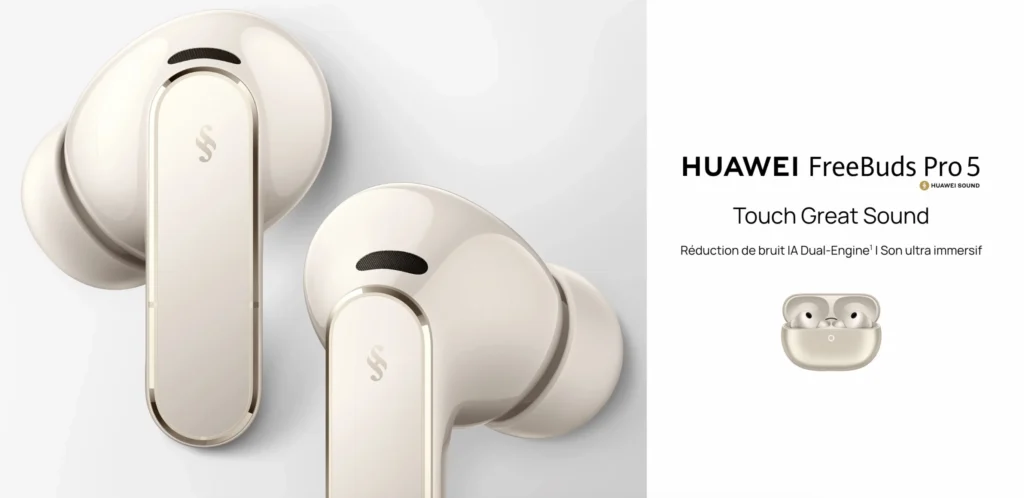
Huawei FreeBuds Pro 5: The First ANC ‘Dual-Engine’ for Absolute Silence
Huawei is repositioning its high-end earbuds with a straightforward yet ambitious promise: more silence, higher fidelity, and clearer calls even when the city is roaring. The FreeBuds Pro 5 introduce a ‘dual-engine’ approach to noise cancellation, while enhancing lossless audio transmission with the proprietary L2HC 4.0 codec (up to 2.3 Mb/s).
The premium wireless earbuds market has become a battleground, with AirPods Pro, Sony, Bose, and Samsung all promising the ultimate ANC. Huawei is taking a different route: breaking down noise (constant bass vs. sharp peaks) and handling each category differently, backed by an AI layer that continuously adjusts.
ANC Dual-Engine: Two ‘Engines’ with Real-Time AI Adjustments
Huawei highlights a dual-transducer ANC architecture:
- A dedicated driver for constant and low-frequency noises (vehicles, machinery, subway)
- A micro-planar diaphragm for more ‘irregular’ and high-frequency sounds (voices, claps, sudden peaks)
All of this is managed by a MIMO ‘detection’ model analyzing the environment and making up to 400,000 adjustments per second to adapt noise cancellation in near real-time. There’s also a transparency mode and adaptive volume control designed to prevent the “I turn up the volume without realizing it” effect in loud streets or transports.

From Hi-Res to ‘Lossless’ (If Your Device Supports It)
An additional strong point is lossless transmission via L2HC 4.0, claimed to reach up to 2.3 Mb/s at 48 kHz/24 bits on compatible devices. Huawei pairs this with a Dual-Drive architecture (physical separation of low/high frequencies) and multiple predefined sound profiles (Balanced, Voice, Classical, Bass depending on markets/communications).

It’s important to note that this ‘lossless’ feature will heavily depend on the phone (proprietary codec). With other devices, the experience will revert to more standard codecs (often AAC/LDAC depending on ecosystems and settings).
Calls: Micro + Bone Conduction for Clarity
Huawei claims a three-microphone setup plus a bone conduction microphone, with AI processing to isolate the voice. The brand promises intelligibility in environments up to 100 dB of ambient noise and wind resistance (numbers may vary based on communications).
On paper, the approach is coherent: bone conduction serves as a more stable ‘voice reference’ when standard microphones are overwhelmed by the environment.
The FreeBuds Pro 5 focus on dual-device connectivity (multi-device), Audio Sharing (sharing a stream with a second compatible Huawei headset), and customization via an app (iOS/Android).

Design and Endurance: IP57 Rating and More Compact Case
On the product design front, Huawei describes a ‘Star Oval’ design, a more compact case, and an IP57 certification (dust-resistant and limited immersion).
Regarding battery life, a specialized source indicates up to 8 hours without ANC/33 hours with the case, or 5 hours with ANC/22 hours with the case (typical values, to be considered as indicative based on volume, codecs, and conditions).
Pricing and Availability: €199.99 and Launch Offers
In France, multiple publications report a launch price around €199.99, with temporary promotions depending on channels. Launch offer: until April 5, 2026, receive a €30 immediate discount on Huawei’s online store.
The FreeBuds Pro 5 do not aim to “outdo everyone” — they primarily target three scenarios where premium earbuds excel in daily use:
- Transportation/Open spaces: Adaptive ANC is genuinely useful as it reduces variations (voices, announcements, peaks).
- Calls in challenging environments: If bone conduction is well-utilized, it becomes a significant differentiator.
- High-quality listening: The 2.3 Mb/s is a strong marker… but especially for users in a compatible ecosystem.
The gamble is thus ‘premium pragmatic’: if you have a recent Huawei phone (or a device that fully supports L2HC), the experience can become very convincing. Otherwise, you may pay for part of a promise (the lossless) that you might not fully leverage — as often happens with proprietary codecs.



