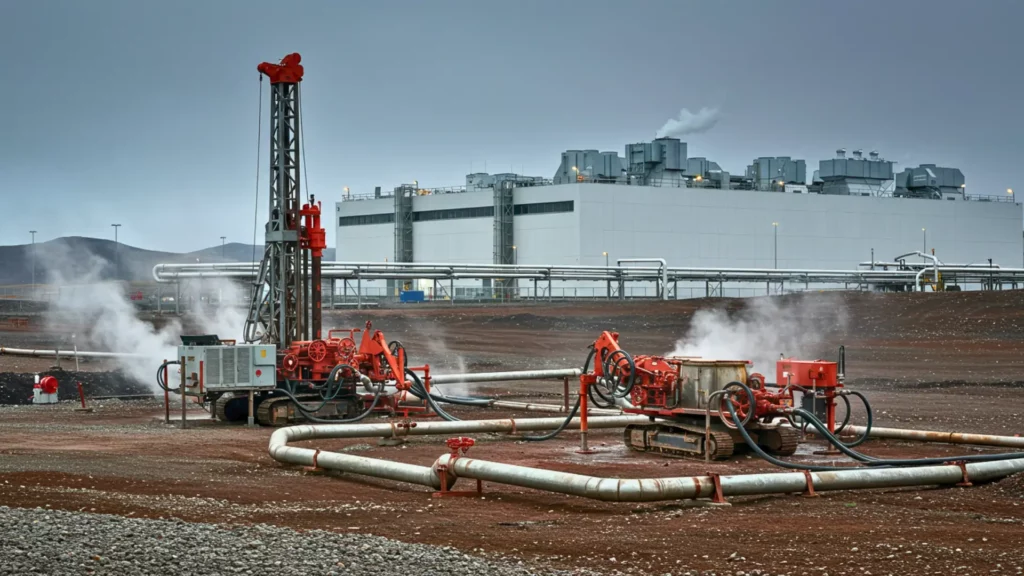
Digital giants promise a decarbonized AI powered by next-generation geothermal energy. However, the technology used underground bears similarities to hydraulic fracturing, raising concerns among seismologists. Here’s a straightforward, educational breakdown of this ambitious yet controversial energy bet.
Why the explosion of generative AI models is driving an unprecedented energy demand and pushing tech giants towards radical solutions
Data centers dedicated to artificial intelligence operate around the clock, utilizing thousands of specialized processors. Every request, every image generated, every model trained consumes electricity and requires massive cooling. As algorithms become more complex, their energy appetite grows at an exponential rate.
According to several industry projections, the electricity consumption linked to generative AI could double by the end of the decade. For tech companies, meeting commitments to carbon neutrality is becoming a colossal challenge. Solar and wind energy, inherently intermittent, struggle to provide continuous production necessary for the persistent needs of servers.
How next-generation deep geothermal energy promises stable, massive electricity production without direct carbon emissions
Deep geothermal energy is based on a simple idea: harnessing the heat naturally stored in rocks several kilometers beneath the surface. This heat, almost inexhaustible on a human scale, can produce stable electricity, independent of weather conditions, without burning fossil fuels.
Recent projects utilize very deep drilling to reach hot, dry rocks. Water is injected under pressure to circulate through fractures, heat up, and then return to the surface. The steam produced drives electric turbines, providing continuous power capable of supplying hundreds of thousands of homes.
Why the technique used closely resembles hydraulic fracturing and alarms the scientific community
To create an artificial reservoir in the rock, engineers use a method similar to hydraulic fracturing known in gas extraction. The high-pressure water injection fractures geological formations to improve thermal circulation. Technically effective, this approach modifies the natural stresses within the underground environment.
Seismologists observe that these injections can reactivate preexisting faults. In some countries, experimental geothermal projects have already triggered microseisms, usually minor but sometimes detectable by local populations. These events, while rarely dangerous, raise questions about risk management on a larger scale.
The challenge lies in prediction. The underground is a complex, heterogeneous environment where pressure and temperature can vary significantly. Even with sophisticated sensors and continuous monitoring, accurately anticipating the extent of a seismic response remains difficult. Thus, the challenge is to balance energy innovation with geological safety.
Between climate promise and seismic uncertainties, a strategic choice reshaping the energy future of the digital world
For digital giants, investing in advanced geothermal energy represents a major strategic lever. This source offers controllable production compatible with power-hungry, continuous data centers. It could reduce reliance on coal and gas while supporting the rapid growth of global AI.
However, the energy transition cannot overlook the affected regions. Local communities demand transparency, rigorous impact studies, and shutoff mechanisms in case of abnormal activity. Social acceptability becomes as crucial as technical performance, especially when the term earthquake comes into play.
In the long run, the question transcends technology alone. It challenges the digital development model itself: should we continue to produce more computing power or optimize the energy efficiency of algorithms? Balancing the promise of low-carbon energy with scientific caution remains an open equation.