

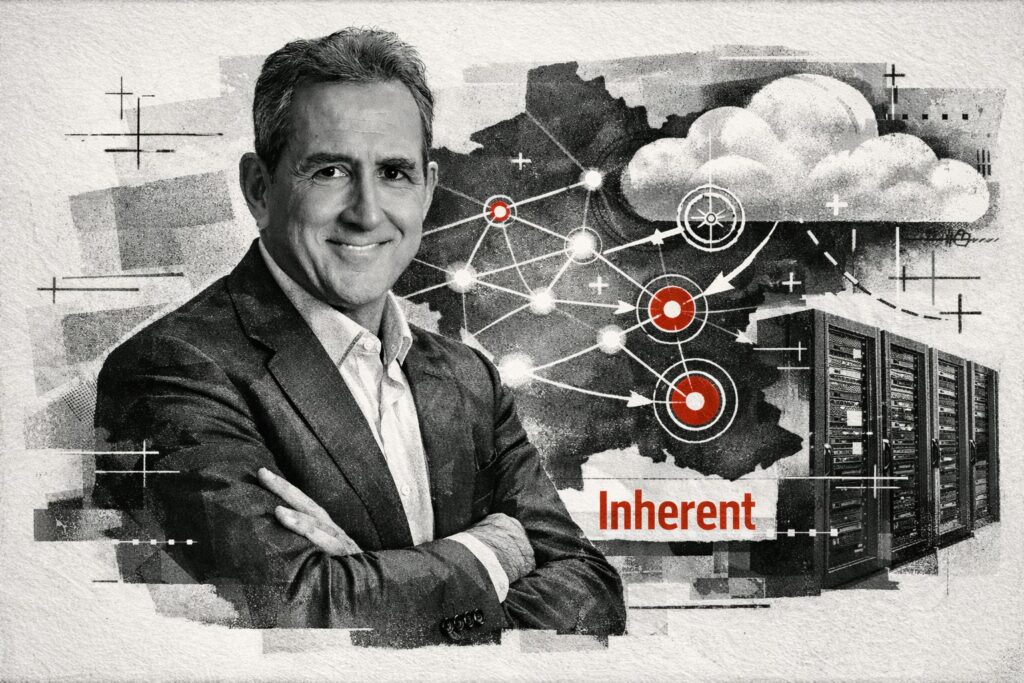
With 43 locations across France, 16 data centers strategically positioned throughout the country, a cybersecurity team of over 120 experts, and a rapidly expanding indirect distribution platform, the Inherent Group positions itself as a model of local proximity and managed services. This approach emphasizes both digital sovereignty and the seamless convergence of network, cloud, and security services. In an exclusive interview with IT Social, Pierre-Jean Beylier, President of Inherent, elaborates on the group’s industrial trajectory, consolidation strategy, and his vision for artificial intelligence and digital sovereignty. He discusses the group’s structure, the synergy between its entities—Adista, Unyc, Devensys, and Upperlink—and the significant challenges surrounding sovereignty, cloud solutions, and AI within the French digital services market.
IT Social: How do you define the Inherent group today and what strategy do you pursue at its helm?
Pierre-Jean Beylier: The Inherent group is built around three core pillars. The first is local proximity, a value inherited from Adista’s DNA. We operate 43 sites across France, nearly 40 of which are dedicated Adista agencies—an unusual setup in the market. This proximity extends to a network of approximately 1,200 Unyc partners nationwide, supported by a private cloud approach with 16 data centers in France. While we could have centralized our infrastructure in a few locations in Île-de-France, we opted for a more distributed model, which we plan to enhance further. Six of these data centers are owned by us.
The second pillar is our ability to meet the key communication and IT service needs of our clients. We focus on four main areas: connectivity through local and wide area networks; communication and collaboration, covering fixed and mobile telephony and collaborative suites; cloud services and IT infrastructure; and finally, cybersecurity, which is growing rapidly.
How does this organization reflect on Inherent’s structure, particularly regarding Adista, Unyc, and the specialized entities?
We operate through two main sales channels. Adista focuses on direct sales, catering to larger clients like SMEs, mid-sized companies, and increasingly larger accounts seeking higher quality of service and agility. Unyc targets the market indirectly via our 1,200 partners, primarily addressing small businesses and local communities. In recent years, we’ve also added two specialized units: Devensys, which offers expertise in cybersecurity, and Upperlink, which concentrates on our Microsoft ecosystem, data, Business Intelligence, and AI capabilities. Devensys engages directly with major accounts while becoming a key supplier for Adista in the mid-market segment. Adista serves as the single point of contact for clients, coordinating the efforts of Devensys experts, cloud professionals, telephony specialists, and Upperlink consultants as needed. This model epitomizes our principle of “one Inherent.”
When you joined, there was a goal to double revenue by 2026. Do you believe you have achieved a satisfactory level of industrial coherence to meet this target, and what still needs to be added to the Inherent mosaic?
In terms of skills and expertise, we have reached a high level of coherence. We have secured cybersecurity contracts against specialists and succeeded in cloud projects against dedicated players. Our telecommunications and telephony services remain robust. My philosophy on acquisitions is straightforward: we acquire a company when we are convinced that we can win contracts together that none of our individual entities could secure alone. This was exemplified when we won a significant cybersecurity contract through a public procurement process—something that neither Adista nor D26 could have achieved independently. It was our combined expertise that established our credibility.
Some competitors are more focused on specific business applications. Why should clients choose Inherent over other providers?
We are a service-oriented company. Our clients expect managed services and a subscription-based model. About 90% of our revenue comes from recurring revenues generated through managed service subscriptions. We have embraced vertical market strategies over the past few years, establishing dedicated teams for public service, healthcare, retail, regulated professions, and more. We are certified health data hosting providers across ten data centers in France and have recently achieved SectNumCloud qualification, solidifying our stance on sovereignty and security. In retail, our expertise in deploying large-scale multi-site networks allowed us to win a major contract to connect thousands of stores within just a few months, combining fiber, SD-WAN, and advanced security functions. These verticals help us gain a nuanced understanding of our clients’ business constraints.
The European service market is currently experiencing ongoing consolidation and the formation of sovereign ecosystems. What is Inherent’s position in this context?
We are one of the players in this consolidation movement. We acquire companies each year to either enhance our expertise or expand our geographical coverage. Despite our agency network, there are areas where we are not present—certain large cities still lack an Inherent office. Our strategy involves accelerating organic growth by leveraging our combined expertise and local presence, alongside targeted external growth to strengthen our foundation. The opportunities for consolidation in the French market are plentiful, and I believe that 2026 will be a particularly dynamic year.
Regarding sovereignty, you stress the importance of localizing infrastructure and teams. How is this sovereignty reflected in your offerings and your clients’ demands?
Pierre-Jean Beylier: Inherent is sovereign by design. Our ownership is French, and the vast majority of our 1,400 employees work within France. Our data centers are located on French soil. When the best solutions are not sovereign—such as when it comes to Microsoft’s dominance in collaborative suites—we provide French alternatives like Wimi. We strive to offer sovereign options wherever it makes sense. In the public sector, the sensitivity to sovereignty is heightened, especially among vital operators and in sectors particularly exposed to security and espionage concerns. However, the principles of sovereignty often encounter budget constraints; in the current economic climate of low growth and increased pressure on corporate tax, cost remains a pivotal factor. Non-sovereign solutions sometimes present a more favorable overall cost of ownership. Our responsibility is to provide the best possible solution based on needs and context. When we can offer sovereign solutions, we do, but it’s not yet the majority of cases. We are at the beginning of a slowly growing wave.
You mention Atlas as a key platform for indirect sales. Could it become the flagship platform of the Inherent group, akin to major software platforms?
Atlas certainly holds a strategic position. However, I wouldn’t say that the platform alone is becoming the flagship. We are undertaking significant investments across all our information systems, aiming for a global competitive advantage. Some components of Atlas enhance direct sales, while elements from direct sales enrich Atlas. We aim to maximize the strengths of both worlds to build a unified platform. Atlas is ahead in automation and digital client relationships for our partners, which will inspire our direct sales efforts. Feedback from resellers indicates that the platform currently ranks among the best in the market, though it must be complemented by consistent service quality, dynamism, and the creativity of our teams.
What is the status of your work surrounding artificial intelligence, both for your internal operations and for your clients?
Internally, over a year ago, we identified about fifteen use cases to initiate our AI efforts. AI plays a clear role in operational and technical support, but we also utilize it for functions like marketing, utilizing tools like Gemini to accelerate content production, and within business applications like ServiceNow, from which we leverage AI capabilities. Furthermore, we are developing our own AI agents, harnessing Upperlink’s expertise to design AI solutions for both ourselves and our clients. We offer GPU as a service in our data centers and are considering extending beyond just infrastructure. The goal is to build solutions around well-defined use cases. We have launched a strategic reflection with specialized consultants to shape what our AI offering should be for clients in the next two to three years.
In conclusion, how do you see the evolution of the digital services market in the coming years?
Pierre-Jean Beylier: I expect a significantly more consolidated market. Clients will require providers who can address all their challenges; it’s becoming increasingly difficult to discuss networking without touching on cybersecurity or cloud solutions without incorporating both networking and security. The convergence of these topics is becoming more pronounced. Players that boast strong competencies across these areas will be better positioned. Cybersecurity will continue to grow in importance, and AI will play a role for both attackers and defenders. The network, often viewed as a commodity, will regain its central role, as both AI and cloud require more robust and resilient transport capabilities.
I also believe that the model will evolve towards a more thoughtfully designed hybrid cloud. We will see fewer extreme strategies where everything is placed in the public cloud—risking vendor lock-in and high costs—or all kept on premises, which puts increasing strain on cybersecurity. We will work more closely with clients to determine the most logical placement for each type of infrastructure and each set of data. Meanwhile, we will continue to grow to become a reference in the digital sector in France. Our goal remains to achieve €500 million in revenue by 2027, with aspirations for even more ambitious targets thereafter, ensuring we reach the critical size necessary to invest, capture new markets, and acquire new companies.



