

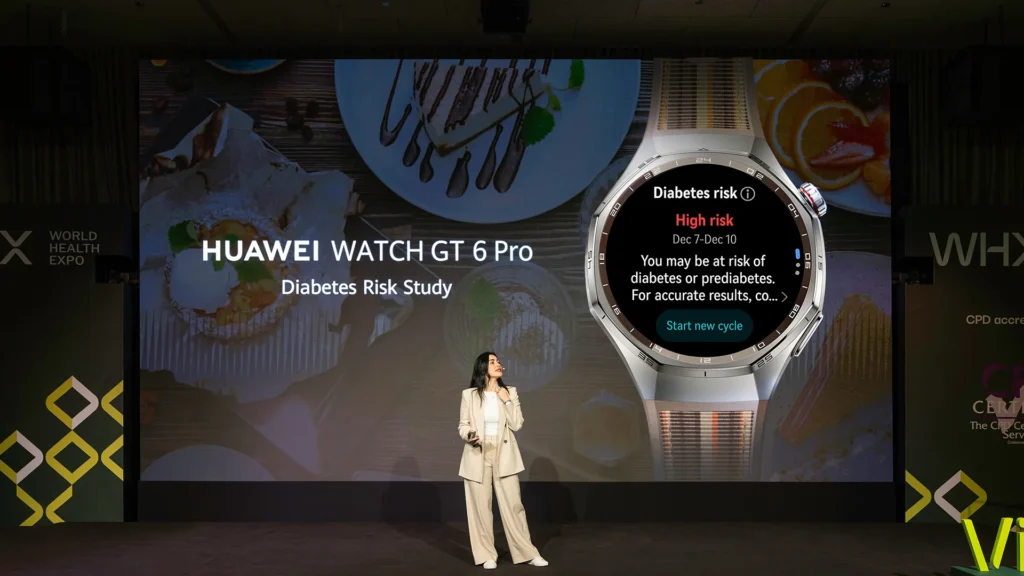
Huawei Watch GT 6 Pro: Your watch can now assess your diabetes risk
Diabetes is rapidly advancing, often silently— and Huawei aims to disrupt this silence with a new feature called the Diabetes Risk Study on select smartwatches.
The concept is appealing: to detect risk (not measure blood sugar) using data already collected in daily life, encouraging users to seek medical advice before issues develop. However, a critical question remains: how can a watch be ‘preventive’ without becoming misleading?
A PPG Reading That Seeks Weak Signals
Huawei relies on photoplethysmography (PPG)— these optical sensors which detect blood flow variations beneath the skin, used for measuring heart rate and sometimes oxygen saturation. The brand promises a broader analysis of cardiovascular patterns over 3 to 14 days, with results classified as low/medium/high risk and a clear recommendation: consult a doctor if the results are medium or high.
A crucial point: Huawei emphasizes that this is not a medical device and does not diagnose diabetes. It is an orientation tool designed to lead users to clinical screenings (fasting glucose, HbA1c, OGTT).
Validation: The Right Approach… If The Results Follow
Huawei highlights its collaboration with Dubai Health to compare smartwatch signals with hospital reference tests. From a narrative standpoint, this is the right direction: the ‘wellness’ promise requires clinical backing, even if it remains non-medical.
Innovation that truly cares.
At World Health Expo Dubai 2026, Huawei turned heads unveiling its new 24/7 blood sugar monitoring feature now live on #HUAWEIWATCHGT6Pro, alongside its revolutionary blood pressure monitoring on #HUAWEIWATCHD2. pic.twitter.com/3x5jmEiSkb
— Huawei Arabia (@HuaweiArabia) February 11, 2026
However, until we get public figures (sensitivity, specificity, false positive/negative rates), details on tested populations, and independent validation, we remain in a realm where marketing can outpace science.
Availability: Watch GT 6 Pro First, Expansion Later
The rollout has begun with an OTA update on the Huawei Watch GT 6 Pro, with plans to extend to other models.
This type of ‘risk’ can prove useful for a simple reason: a watch is worn daily, allowing it to identify trends and promote public health reflexes (getting screened). However, there are two traps:
- False positives: unnecessary anxiety, increased consultations, loss of trust.
- False negatives: misleading sense of security (“my watch says low risk, so I’m fine”).
The correct usage is to treat this feature as a signal for prevention, not a verdict. In clear terms: if the watch ‘alerts’, you check; if it does not alert, yet symptoms or risk factors exist, you check anyway.
If Huawei manages to strike this balance, we could witness a significant shift: wearables would not merely quantify but act as guides toward screening. A watch that does not diagnose illness but prompts timely attention to one’s health — that may well represent the mature version of ‘connected health.’



