Apple delays its M5 Pro and M5 Max chips: a March launch becomes likely, betting on SoIC packaging
Apple prefers smooth launches, but this time something seems off: the M5 Pro and M5 Max chips are taking longer than usual, past the typical timeframe observed during the previous generation (the M4 Pro and M4 Max were announced in late 2024 with the new MacBook Pro). According to a leak from China, we might not see the new chips before March 2026.
This apparent delay hints at a deeper, more significant issue: as the easy gains from smaller manufacturing processes become scarce, the focus shifts towards architecture and especially packaging (advanced chip assembly), which has become a critical battleground for performance.
M5 Pro and M5 Max: A Likely March Launch But Still Uncertain
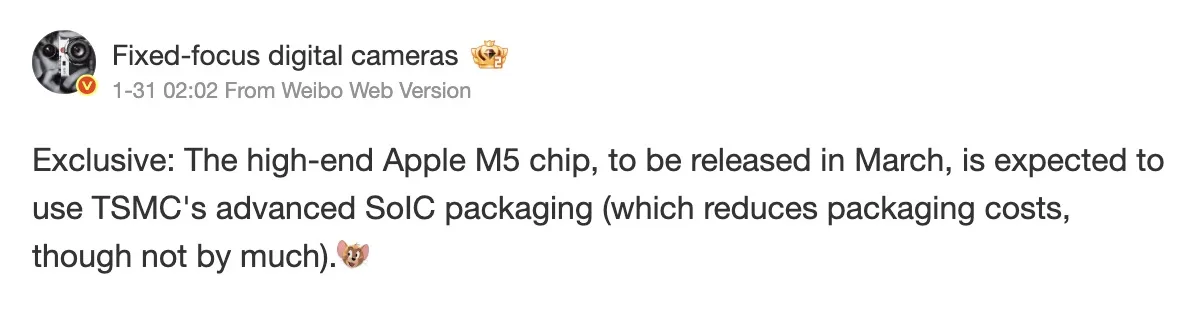
The rumor originates from a leaker on Weibo, suggesting that Apple is aiming for an announcement in about a month, specifically in March 2026, without officially explaining the delay.
At this point, it’s important to clarify: this isn’t a confirmation, but rather an indication. It aligns with another hint: the document emphasizes production constraints and an increased focus on more sophisticated packaging techniques.
SoIC: The Real Issue Behind The Delay
What makes this leak particularly intriguing is not the release date, but the underlying technical reasons: Apple is preparing its M5 Pro and Max chips using TSMC’s SoIC technology, a “3D stacking” method designed to integrate various components more effectively within a single package.
On paper, SoIC meets several key criteria for 2026:
- Increased chiplet flexibility: TSMC promotes SoIC as a foundation that facilitates chip-level integration and modular designs.
- Improved efficiency: The goal is to enhance functional density and bandwidth while reducing latency and energy consumption per bit.
- But added industrial complexity: TSMC acknowledges that integrated 3D technology poses challenges, particularly regarding thermal management and yield. In other words, this could impact the timeline.
This is where the rumor gains significance: Apple is not just delaying a chip—it might be shifting its methodology to continue advancing without escalating energy consumption or thermal issues.
Temperature, Costs, Constraints: The Trio Driving Apple’s Decisions
The leak also highlights a very concrete concern: worries about overheating with the standard M5 chip, which has reportedly reached temperatures of around 99°C under sustained load. This kind of data should be taken with caution, but the intuition makes sense: as performance and density are pushed, thermal issues become critical, and advanced packaging also plays a role in managing this.
On the cost and manufacturing capacity fronts, the overarching trend is well-documented: advanced packaging is becoming a strategic bottleneck across the industry, as it’s where the next generations will be gained (or lost), especially under AI pressure.
Therefore, a “one-quarter” delay can reflect a straightforward reality—the industrialization of the new package is more challenging than anticipated.
What Does This Mean For Future Macs?
If the M5 Pro and Max arrive in March, Apple could introduce them with a new wave of machines—typically professional laptops or a desktop geared towards creators. However, caution is warranted: no specific products have been confirmed in the leak, and Apple might announce chips without immediately aligning the entire range.
The key takeaway is the direction Apple seems to be heading: it looks like they want to make the M5 Pro and Max a significant architectural advancement rather than just an incremental frequency improvement. This type of strategic decision always affects timing.
A Delay That Appears Strategic
Behind the “delay,” one can discern a significant shift: Apple, like the rest of the industry, is treating advanced packaging as a vital lever for performance and efficiency—one that is more complex to master than merely scaling up manufacturing processes.
If March 2026 is confirmed, it won’t just mean “finally, a launch.” It will signify a marker of an era where power is achieved not just through silicon, but through how it is assembled.