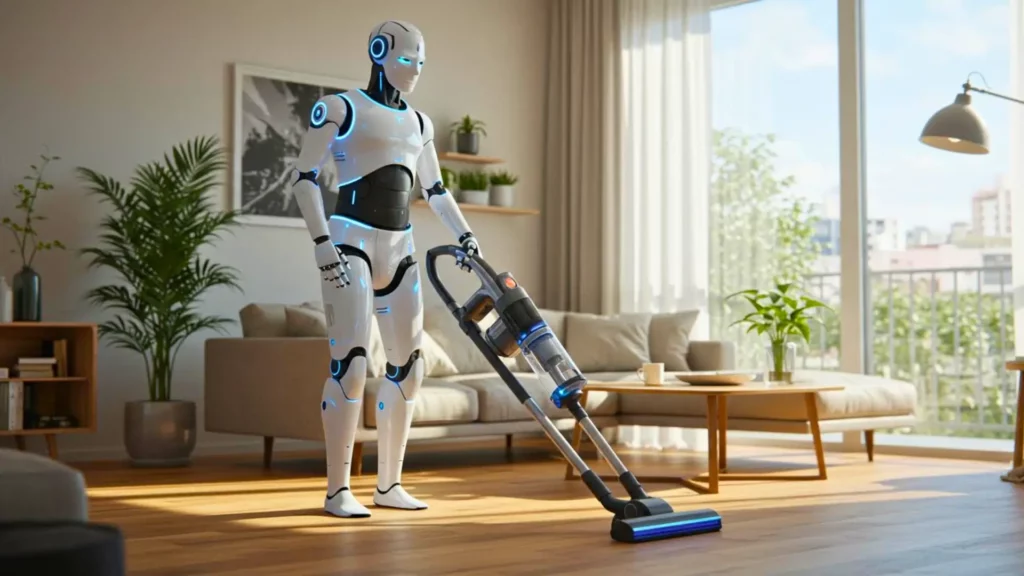
Elon Musk insists that the humanoid robot Optimus will be available to the public by the end of 2027. However, after five years of unimpressive demonstrations, shifting promises, and spectacular announcements, it’s hard to greet this latest statement without some skepticism. Doubts are creeping in once again.
Behind The Announcement At Davos: A Repeated Timeline Without Concrete Deliverables
It’s hard to escape the feeling of déjà-vu after Elon Musk’s latest statement at the World Economic Forum in Davos. Indeed, Tesla Optimus is expected to be available by the end of 2027. For five years, the Tesla CEO has been announcing the imminent arrival of this revolutionary humanoid robot. Yet, no concrete evidence of its advancement has been shown.
Since its initial presentation in 2021, Optimus has claimed to perform a variety of tasks: lifting loads, assisting in factories, cooking, serving coffee, and more. However, amidst unconvincing videos, demonstrations propped up by human operators, and a lack of public tests, the project seems far from delivering a robot capable of replacing humans in everyday life. Musk asserts that prototypes are already working in Tesla factories, but no tangible proof has been provided to support these claims.
Designing A Versatile Robot: A Technical Challenge Still Out Of Reach
Creating a truly autonomous, reliable, and safe humanoid robot remains a colossal challenge today. It necessitates designing a machine capable of manipulating fragile objects, moving within complex environments, and interacting safely with humans. Yet, no company has achieved this level, not even Boston Dynamics after twenty years of research.
Moreover, Tesla is still in its early stages in this field. The recent departure of Milan Kovac, the head of the Optimus project, raises further questions. Regarding the proposed timelines, they appear once again very unrealistic. Musk tempers his commitment by stating that commercialization would occur only if Tesla is “fully confident,” a vague formulation conveniently used to justify future delays.
A Carefully Executed Communication Strategy That Continues To Ignite The Stock Market
It’s striking to observe that every announcement from Musk triggers an immediate rise in Tesla’s stock. For instance, after his speech at Davos, the stock surged by more than 3% within hours. It’s no longer an industrial project captivating interest, but rather a technological myth, fueled by the promise of a future always just out of reach.
Yet, instances of unfulfilled commitments abound: autonomous driving, robot taxis, crewed flights to Mars… All projects that are always “on the verge” of becoming a reality. Therefore, Optimus might well be the next on this growing list.
Challenging To Imagine A Mass-Market Humanoid Robot Available By 2027
The question remains: should we still believe in a public release by 2027? Certainly, advances in AI and robotics are undeniable. However, envisioning a reliable, mass-produced humanoid robot that is financially accessible within such a short timeframe seems highly improbable.
In reality, it seems more realistic to expect Optimus to continue making appearances in orchestrated demonstrations. It will execute a few simple tasks in controlled contexts, and its commercialization will likely be postponed once again. And again.
In the realm of robotics, scientific rigor, repeated testing, and observable results remain essential pillars. Ultimately, these elements are far more solid than spectacular promises. Innovation is not measured by the boldness of a speech but by the consistency of real progress. In this area, Tesla still needs to prove itself.