

Lancom Systems Aims to Double Active Partners in France in Just One Year
Lancom Systems, a German network manufacturer known for its entirely indirect business model, is setting an ambitious goal to increase its active partners in France from fifty to one hundred within a year. The company plans to make its mark at IT Partners 2026, taking place on February 4 and 5 at the Paris La Défense Arena. Supported by distributors Kappa Data and IPsteel, Lancom is placing a strong emphasis on its Lancom Management Cloud as a central monetization tool for integrators.
The landscape of “post-sovereignty” procurement has evolved beyond merely focusing on data hosting, encryption, or localization. A new concern has emerged further down the stack—supply chain coherence. If a single uncontrolled link exists, it can undermine the entire promise of control. This shift signals a significant change in selection criteria among integrators and their end clients, marking the increased visibility of European network players in the French market as more than just opportunistic; it highlights a fundamental realignment of priorities.
At IT Partners 2026, Lancom will showcase its solutions alongside its distributors—Kappa Data at booth E027 and IPsteel at booth D024—with a specific focus on recruiting regional resellers and integrators. Emphasizing its “100% indirect” model, the company positions channel dynamics at the core of its France strategy. Isabelle Sinègre, the company’s sales director for France, highlights this approach as a “strategic pillar” essential for building a credible and sustainable European alternative in network infrastructure.
From Data Sovereignty to Network Building Blocks Sovereignty
Lancom offers a comprehensive portfolio that includes switches, Wi-Fi access points, routers, firewalls, and SD-WAN solutions, along with a proprietary operating system and a unified management console hosted in Europe. This product offering emphasizes integration, underscoring the idea that if even one component is not sovereign, the integrity of the entire chain is compromised—especially in contexts geared towards operational needs and maintaining operational conditions.
This pivot toward network infrastructure resonates with significant on-the-ground interests, particularly in multi-site deployments spanning local governments, logistics, educational institutions, healthcare facilities, and hospitality. The French market is characterized as “very fragmented,” with local partners and integrators serving as key influencers where trust and proximity weigh as heavily as technical specifications. The channel-focused approach at IT Partners acts as a catalyst, as resellers’ economic viability hinges on their ability to industrialize, monitor remotely, and bill for services, rather than just selling standalone boxes.
The Central Role of Lancom Management Cloud
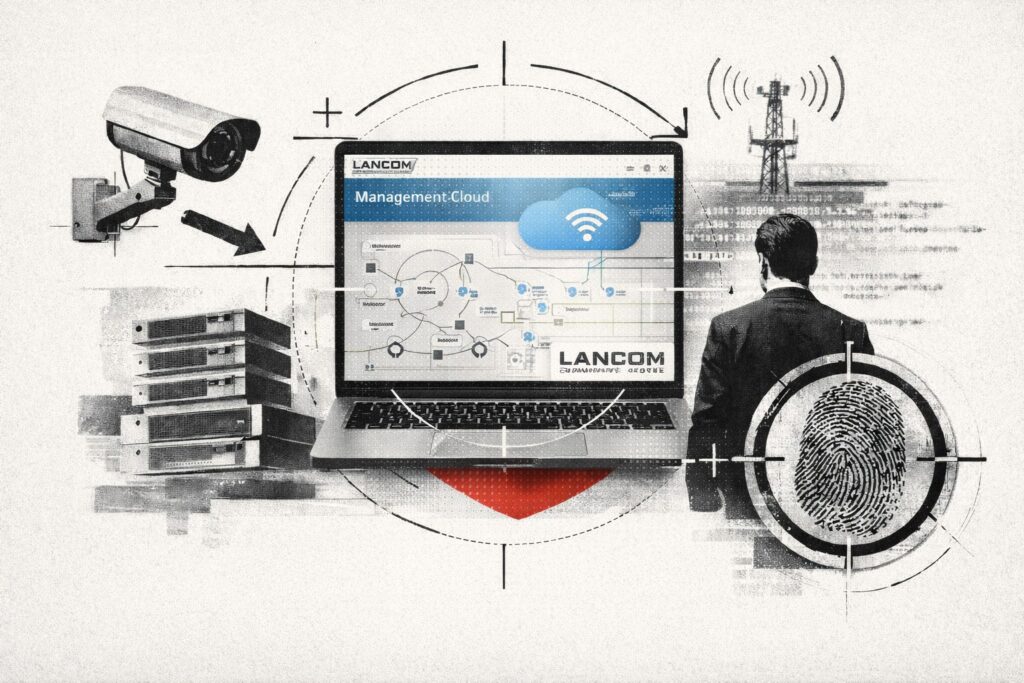
In this strategic context, Lancom Management Cloud takes center stage, delivering essential functionalities expected by integrators, such as auto-provisioning, multi-site deployment, and delegated administration at multiple levels. The company emphasizes service value, describing the console as “the nerve center for service monetization” for its partners. Upcoming 2026 product developments will enhance dashboard personalization, provide consolidated insights into license renewals and end-of-life statuses, and allow deeper integration of firewall management from the platform—all geared towards operational teams.
Lancom’s focus on software provides centralized management designed for distributed environments, complemented by support and service approaches that reassure a channel accustomed to comparing operational costs, not just theoretical throughput.
A Performance-Driven Product Strategy
To materialize its offerings, Lancom introduces the LANCOM R&S UF-560, advertised as a “high-performance” firewall for demanding professional environments. According to its launch specifications, the firewall can achieve throughput of up to 20 gigabits per second and UTM throughput of 1.5 gigabits per second, supporting up to 3,000 VPN tunnels, with eight Gigabit Ethernet ports, two SFP+ ports, an expansion slot, and options for high availability in clusters. A key feature is the integration between inspection, segmentation, and centralized management via the Lancom Management Cloud—this connection between monitoring and security is crucial for integrators looking to industrialize their offerings.
Lancom also incorporates various inspection mechanisms, including SSL inspection and deep packet inspection, alongside machine learning-based detection approaches. The focus here is not on generic security promises, but rather on the ability to operate these functions at scale, with manageable compliance policies, alerts, and remote configurations to prevent rule stacking from becoming a source of errors in production. In multi-site environments, these technical governance details are critical, especially when partners must maintain service commitments across heterogeneous infrastructures.
A Four-Tiered Partner Program
Lancom has structured a four-tier partner program—Bronze, Silver, Gold, and Platinum—with the explicit goal of doubling its active partner base within the year. Announced benefits include NFR hardware quotas starting at the Silver level, complimentary units for Gold partners, and prioritized technical support for Platinum members. Additionally, there will be certified training, web training, and pre-sales and operational support offered. Partners will receive various resources from the outset, including lab equipment for proof of concept and demonstration access to the management console, with annual checkpoints to ensure alignment with agreed-upon engagement levels.
Two specific mechanisms are particularly beneficial for partners: project protection through a partner relationship management portal, described as a tool for account or project reservation, and an activatable service chain with distributors. Lancom will offer pre-sales support and training in French through Kappa Data and on-site training with IPsteel, crucial for regional resellers who may lack dedicated engineering teams. This strategic focus is also anchored in the strength of Rohde & Schwarz, Lancom’s parent company, as articulated by Isabelle Sinègre, who underscores “trust and sustainability” as top priorities in an unstable geopolitical context.
The market narrative is clear. As a European network manufacturer intensifies its investment in the French channel, setting defined partner recruitment targets while prominently featuring a management console and service mechanisms, it indicates favorable commercial and technical conditions for partners and end-clients alike to leverage network infrastructure as a differentiating factor in the “post-sovereignty” landscape. For integrators, the opportunity lies in standardizing deployments, reducing deployment times, and billing for supervision, security, and operations, rather than merely substituting brands.



