

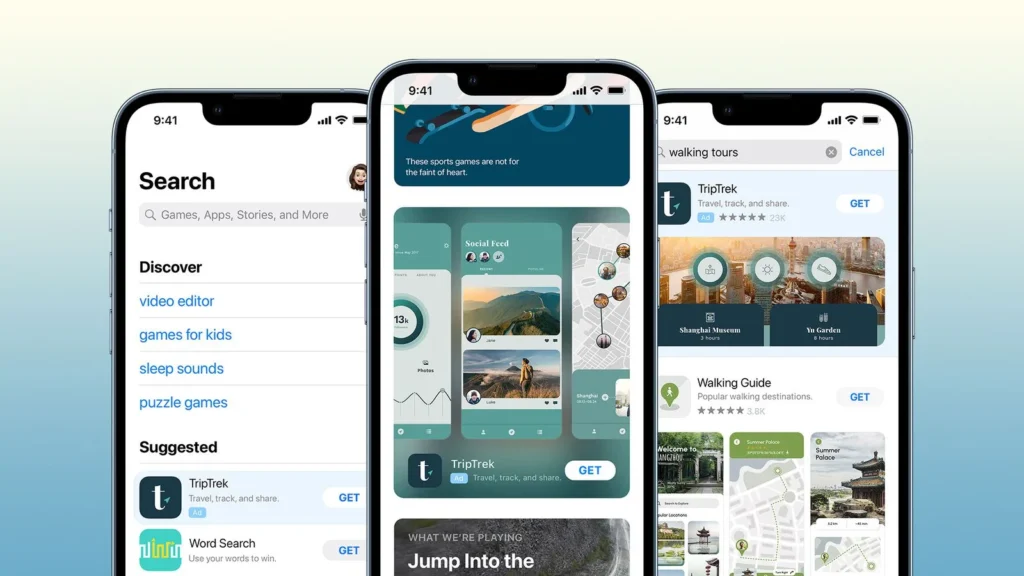
App Store: What the New Ad Design in iOS 26.3 Hides
As the App Store continues to optimize, it starts to resemble what Apple has long criticized elsewhere: a showcase where paid content blends with organic listings. With iOS 26.3, some users are encountering a new search ad design that is visually cleaner yet significantly more ambiguous.
A/B Test That Changes Everything: Ads Disappear in the Interface
Previously, sponsored apps in search results were easily identifiable, particularly due to a light blue background. In the test observed on iOS 26.3, this indicator has vanished: ads now adopt the same style as ‘natural’ results, with only a small “Ad” label next to the icon to indicate sponsorship.
On paper, Apple can argue that the information is still present, so users are informed. In practice, this is precisely the type of UI micro-decision that shifts cognitive load onto the user, inherently increasing the click-through rate.
2026: More Sponsored Placements, More Pressure on Discovery
This test comes in a very clear context: Apple has already announced that it will increase advertising inventory in search in 2026, with ads not only at the top but also further down in the results list.
Apple presents this as an expanded opportunity for advertisers (and thus for developers who purchase visibility). However, for users, the equation is harsher: search—already a primary entry point for discovering apps—becomes a more ‘commercial’ area where organic results are increasingly overshadowed by sponsored content.
This dynamic is hard to ignore: Apple officially promotes its ad platform (now Apple Ads) as a major conversion lever, claiming substantial volumes and high performance.
The Real Issue: Trust, Not Just Advertising
The issue isn’t “ads in the App Store”—they have existed for a long time. The real problem is readability. When sponsored content impersonates natural listings, a shift occurs: it’s no longer just about monetizing attention; it’s about monetizing confusion.
For Apple, the temptation is clear: a more integrated design boosts ad performance without adding new intrusive formats. For users, the opposite is true: search becomes less reliable, more suspicious, and thus less comfortable.

A UI Decision… Under Regulatory Scrutiny
One final, more political point: Apple Ads is already under European regulatory scrutiny, with an ongoing discussion about its potential status regarding the DMA (Digital Markets Act). In this climate, an interface that renders advertising less identifiable could fuel a perception of “dark patterns”—even if Apple can argue that the label is still present.
This test appears to signal that the App Store aims to remain a service (and growth) engine as hardware stabilizes. Apple is no longer content to merely host the app economy; it is extracting margins, setting rules, and increasingly selling visibility.
If the A/B test becomes the norm, the question will not be “is it legal?”, but rather “how much trust is Apple willing to trade for a few conversion points?”. This is a negotiation that users cannot refuse.



