

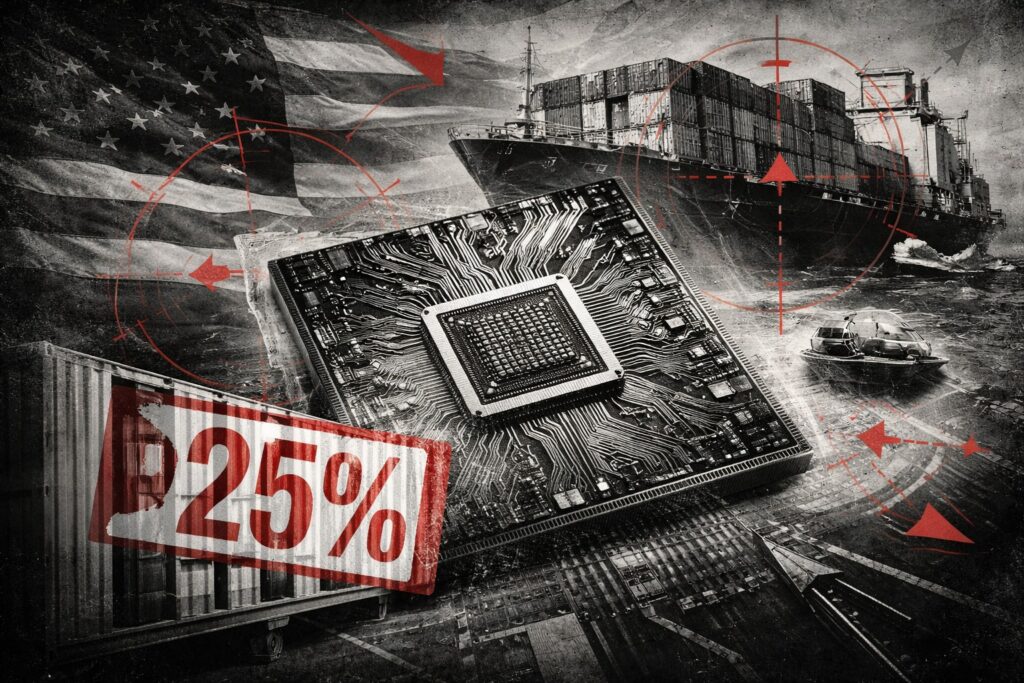
U.S. Imposes 25% Tariff on Advanced Semiconductor Imports Amid National Security Concerns
The U.S. government has officially announced a 25% tariff on a select category of advanced semiconductors imported into the country, a move driven by national security concerns. Effective January 15, 2026, this measure specifically targets processors critical for artificial intelligence and high-performance computing, marking the first phase of a potentially evolving policy.
For several years, the reliance of the United States on Asian supply chains for the most advanced chips has sparked strategic debates surrounding industrial sovereignty, national security, and technological competitiveness. The White House’s recent decision represents a significant shift in strategy, reinforcing existing trade measures without implementing a broad tax on the entire sector.
Rather than a completely new initiative, the announced tariff builds on existing duty structures, layering an additional 25% charge on a limited list of so-called advanced semiconductors. These semiconductors are primarily used for training and executing artificial intelligence models or for high-performance computing tasks. The move is supported by findings from an inquiry conducted under Section 232 of the Trade Expansion Act of 1962, which allows for trade restrictions if imports are deemed detrimental to national security.
A Gradual Push Rather Than a Disruption
The narrow scope of the measure reflects a deliberate, incremental approach. Washington’s goal is not to abruptly disrupt the technological ecosystem, but rather to send a clear signal to industry players. The aim is to encourage designers and manufacturers to increase domestic production capabilities, especially as the U.S. remains heavily reliant on manufacturing facilities in Taiwan and South Korea for its most advanced technological nodes.
To mitigate any adverse effects on the U.S. digital economy, the policy includes several exemptions. Imports of semiconductors used for local infrastructure, civilian research, certain industrial applications outside of data centers, and to support startups are excluded from this additional tariff. This nuanced approach underscores a desire to protect domestic innovation while applying tariff pressure on segments considered strategic and replaceable in the medium term.
Exemptions to Safeguard the Domestic Ecosystem
Geopolitically, this announcement occurs within a climate of heightened technological competition and shifting industrial alliances. U.S. partners in Asia are closely monitoring developments, aware that the scope of these tariffs could expand in a future phase. This decision adds uncertainty to global supply chains and accelerates discussions on diversifying production sites while balancing costs, security, and regulatory compliance.
In the short term, the operational impact remains manageable due to the outlined exemptions. However, in the medium term, this decision introduces additional strategic constraints for semiconductor companies, prompting them to reassess their investment strategies, logistics, and exposure to national industrial policies. It reinforces the notion that microelectronics are perceived by Washington as a critical lever of economic and technological power.



