

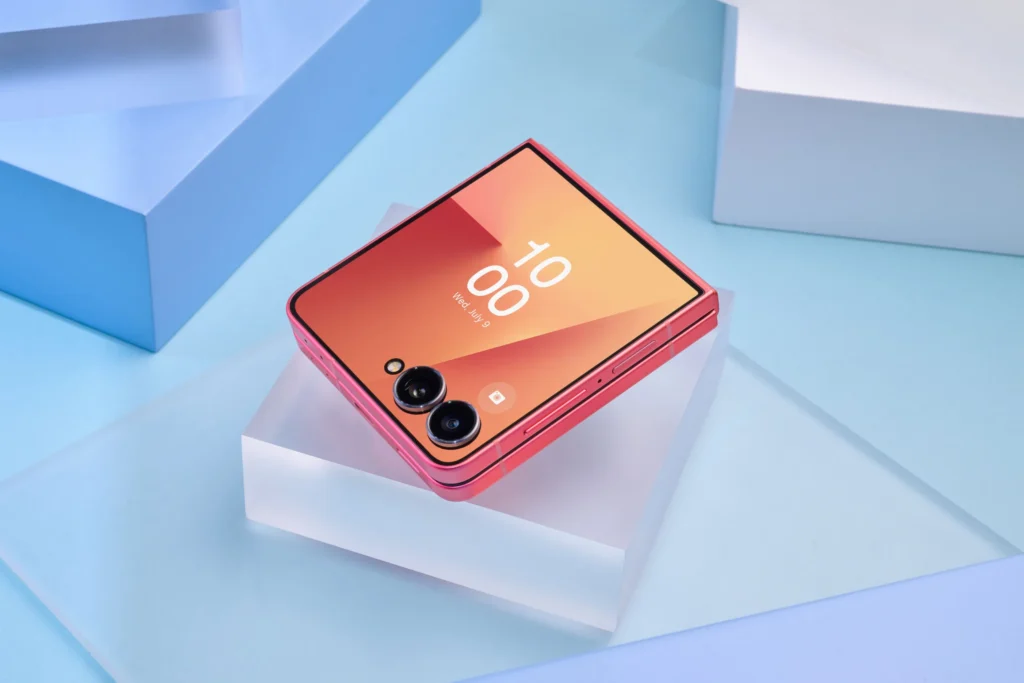
Galaxy Z Flip 8: Samsung would (again) keep the same cameras, and it’s not an accident
If you were looking forward to the Galaxy Z Flip 8 as the generation that would finally break the camera barrier for foldable smartphones, a recent leak might dampen your enthusiasm.
According to Galaxy Club, Samsung would retain the exact same camera architecture on the Galaxy Z Flip 8 as on the Galaxy Z Flip 7 — continuing the same approach as in previous generations.
An unchanged trio: 50 megapixels + 12 megapixels, and 10 megapixels inside
The configuration remains familiar:
- 50 megapixels for the wide-angle (f/1.8)
- 12 megapixels for the ultra-wide-angle (f/2.2)
- 10 megapixels for the internal “selfie” camera (f/2.2)
What’s disappointing is not just the lack of novelty: it’s the feeling that Samsung seems to consider this setup as “sufficient” and prefers to allocate its budget elsewhere (external screen, hinge, slimness, chip, etc.).
Galaxy Z Flip 8: Samsung neither fixes nor improves
On a clamshell foldable smartphone, photography often involves more than just the specifications: FlexCam, viewfinder on the external screen, creative angles, hands-free videos. Samsung already has a usability advantage, and it seems determined to capitalize on the existing formula rather than reinvent it.
However, as traditional smartphones have made photography a nearly automatic selling point, a stagnant Flip can quickly give the impression of paying for design while compromising on other features.
The “small hope”: same megapixels, but better sensors?
Even though the configuration may remain the same, several sources suggest a possible nuance: Samsung could change the sensors (size, aperture, processing) without altering the camera list.
This type of “silent” evolution is often employed by brands to claim “better photos” without touching the structure. It’s credible, especially if Samsung focuses more on the photo pipeline (HDR processing, noise, skin, night), video enhancements (stabilization, HDR, encoding), and embedded AI, which often compensates for unchanged sensors.
The real evolution expected: the chip (Exynos 2600) could become the star
Another persistent rumor suggests that the Galaxy Z Flip 8 could switch to the Exynos 2600, the 2nm chip that Samsung is pushing to regain an edge in costs, efficiency, and “in-house” strategy.
This could notably impact photography: improved real-time image processing, energy efficiency gains (video, preview, HDR), and acceleration of certain AI functions (sorting, retouching, enhancement).
In short: there’s no need to add a telephoto lens to enhance the photography experience… but Samsung needs to deliver a tangible, visible progression, not just promises.
Why Samsung would make this choice: the economic pressure of a “tight” year?
Keeping the cameras is also an industrial choice. With pressure on components (notably memory) and the race for integration (hinges, screens, slim design), foldable smartphones are products where each upgrade costs more than elsewhere. If Samsung wants to maintain a stable price — or limit increases — the simplest way is often to freeze some features, which doesn’t immediately hurt sales. Several reports even suggest a similar price point to the Flip 7 in certain markets, making caution even more reasonable.
If you currently own the Flip 6 or Flip 7 and photography is your primary motivation, this leak sends a clear message: the Galaxy Z Flip 8 will likely not represent a “photographic leap.” However, if Samsung improves battery life, performance (Exynos 2600), thermal management, or screen/hinge experience, then the Flip 8 can remain a coherent update — just not in terms of the cameras.



