Snapdragon 8 Elite Gen 6 Pro: The $300 Chipset That Will Skyrocket Smartphone Prices
Qualcomm may be poised to change the landscape of high-end mobile chipsets by 2026. According to a report reported by Wccftech, the American manufacturer is preparing a dual-tier strategy for its next generation of processors: the Snapdragon 8 Elite Gen 6 will feature both a standard version and a Snapdragon 8 Elite Gen 6 Pro variant, the latter being touted as the most expensive mobile chipset ever produced by Qualcomm.
Snapdragon 8 Elite Gen 6 Pro: Qualcomm Targets a Super-Premium Pro Version
According to available information, the Pro version of the Snapdragon 8 Elite Gen 6 could exceed $300 per unit. If this figure is confirmed, it would set a new record for a Qualcomm mobile chipset.
Several factors contribute to this high price:
- adoption of the new Oryon CPU architecture,
- compatibility with LPDDR6 memory,
- manufacturing using TSMC’s 2 nm process, a first for a mass-produced mobile SoC.
Industry data indicates that a single 2 nm wafer could cost upwards of $30,000, significantly inflating production costs. For smartphone manufacturers, the processor alone could account for nearly a third of the total production cost of an Ultra flagship.
Questions About the Actual Price
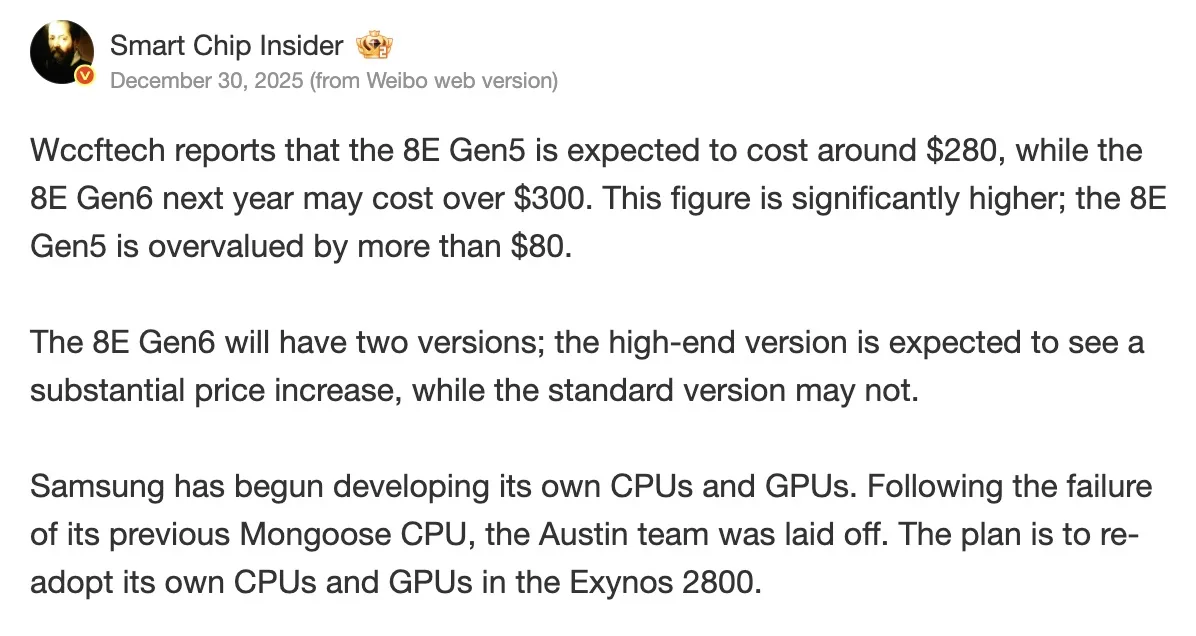
However, not everyone is convinced by these estimates. The source Smart Chip Insider, active on Weibo, questions the accuracy of the figures. They argue that Wccftech is overestimating the price of the Snapdragon 8 Elite Gen 5, projected at around $280, by at least $80.
In this context, rumors suggesting a Snapdragon 8 Elite Gen 6 Pro priced above $300 should be regarded with some skepticism, despite the overall trend indicating rising costs.
Two Chips for Two Types of Flagships
Nonetheless, this dual-tier strategy seems sensible. The Snapdragon 8 Elite Gen 6 Pro would be reserved for ultra-high-end flagship devices, while most premium smartphones in 2026 would adopt the standard version.
The latter would offer:
- a CPU cluster with a 2 + 3 + 3 configuration,
- support for LPDDR5X (as opposed to LPDDR6),
- a more energy-efficient GPU,
- high performance but more stable over time.
In summary, while it may be less impressive on paper, it is likely to deliver a more balanced real-world experience.
The Economic Context Calls for Caution
The decisions of many manufacturers may also be influenced by the ongoing DRAM price crisis, which is already significantly increasing smartphone costs. Between memory, advanced displays, and new camera sensors, the budget for components is rising rapidly.
To avoid another surge in retail prices, many brands may opt out of the Pro version in favor of the standard chipset, perceived as more cost-effective and easier to cool.
In recent years, ultra-powerful chipsets have often been criticized for overheating issues and their negative impact on battery life. In this context, the standard Snapdragon 8 Elite Gen 6 could be appealing due to its better thermal stability and more consistent sustained performance.
If Qualcomm confirms this strategy, 2026 could mark a turning point with a showcase technology Pro chipset, alongside a standard chipset optimized for the mass market.
A delicate balance between innovation, costs, and efficiency — precisely what high-end smartphone manufacturers are currently seeking.