

Samsung unveils a nearly crease-free foldable display at CES 2026: towards a revolutionary Galaxy Z Fold 8
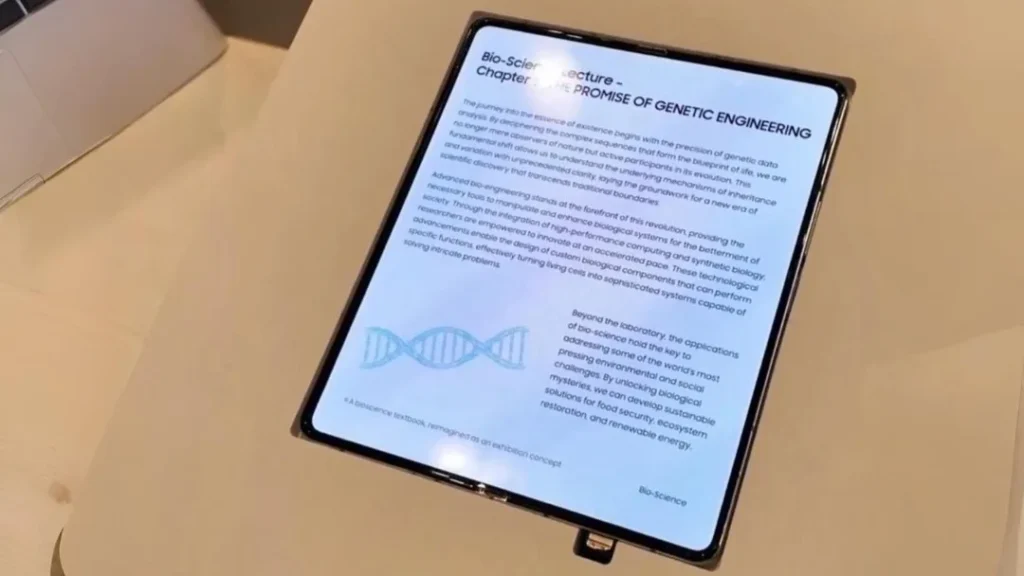
At CES 2026, Samsung Display may have revealed the next significant advancement in foldable smartphones. At its booth, the manufacturer showcased a new foldable OLED panel that drastically reduces — if not nearly eliminates — the central crease, a historical Achilles’ heel of this category.
This discreet demonstration, yet heavily significant, could indicate what Samsung is preparing for its future Galaxy Z Fold devices… or even for external partners.
A crease finally relegated to the background
The prototype was displayed alongside what closely resembled a Galaxy Z Fold 7, providing a direct comparison. The result: once the screen was fully deployed, the surface appeared almost perfectly flat, with only a slight mark visible under specific angles or lighting.
In normal usage, the crease became difficult to distinguish, even more so than on recent generations that were already improved. A short video shared on X by leaker Max Jambor quickly garnered attention, as the difference with the Fold 7 seemed striking.
Samsung Galaxy Z Fold 8 Display at CES👀
— Max Jambor (@MaxJmb) January 6, 2026
This time, it is not simply a cosmetic adjustment, but a deeper technological leap.
A new structural approach to the foldable screen
According to available information, this new OLED panel would utilize a micro-perforated metal plate placed beneath the OLED layer, designed to distribute mechanical stresses more evenly during folding.
This architecture would limit the localized fatigue of the material, the primary cause of crease formation over time. In other words, the screen is not only visually more appealing: it would also be more durable.
Some variants of the displayed prototype also integrate an under-display camera, reinforcing the idea of a panel designed for premium use, without visual interruptions.
Heading towards the Galaxy Z Fold 8?
Samsung has not provided any official indication regarding the final product intended to feature this new screen. However, the timeline leaves little room for doubt: everything points towards the Galaxy Z Fold 8, logically expected in mid-2026.
If this technology is ready for large-scale industrialization, the Fold 8 could become Samsung’s first foldable device to genuinely approach the experience of a conventional tablet when open, without constantly reminding users, visually and tactilely, that it is a foldable screen.
A screen also aimed at Apple?
In the background, another hypothesis is circulating: Apple may be developing its own foldable device, with a launch mentioned for late 2026 or beyond. Samsung Display, being the nearly indispensable supplier of advanced OLED panels, this prototype could also be part of developments intended for Cupertino.
This extreme demand for reducing visible imperfections aligns perfectly with Apple’s standards, known for its near-zero tolerance for aesthetic flaws.
Nothing is confirmed, but this dual path — Samsung and Apple — could explain the unusually intensive effort observed on this prototype.
The crease: the last real barrier to mass adoption
For Samsung, solving the crease problem is strategic. Despite constant progress, it remains one of the main psychological barriers for consumers and a frequently used argument by skeptics to dismiss foldables as expensive gadgets.
A nearly crease-free screen would profoundly change the perception of the format, transforming the Galaxy Z Fold from an “experimental” smartphone into a genuine mature hybrid device, halfway between a phone and a tablet.
The foldable enters adulthood
With this new OLED panel, Samsung Display demonstrates that the battle for foldables is no longer just about thickness, weight, or power, but about the perceived quality of the screen, which is at the heart of the user experience.
If this technology reaches the market in 2026, the Galaxy Z Fold 8 could represent a decisive turning point: the moment when foldable devices stop being an accepted compromise and become an obvious choice.
At this stage, it is no longer just a product evolution — it is a key step in the normalization of the foldable smartphone.



