

Lenovo Unveils Ambitious AI Plans at CES 2026, Centering Around Qira Platform
At CES 2026 in Las Vegas, Lenovo introduced a comprehensive vision for artificial intelligence anchored by its new Qira platform. The announcement underscores a significant refresh in its PC and mobile portfolios, alongside various exploratory concepts. This initiative reflects Lenovo’s strategy to embed AI deeper into the core of its devices and user experiences, transitioning from a purely functional tool to an integral system layer.
For several years, major tech companies have been vying to redefine the narrative surrounding AI, particularly in response to software platforms and model providers. As the world’s leading PC manufacturer, Lenovo aims to leverage its hardware and industrial advantages to create distinctive user experiences without venturing into the realm of generic, interchangeable assistants.
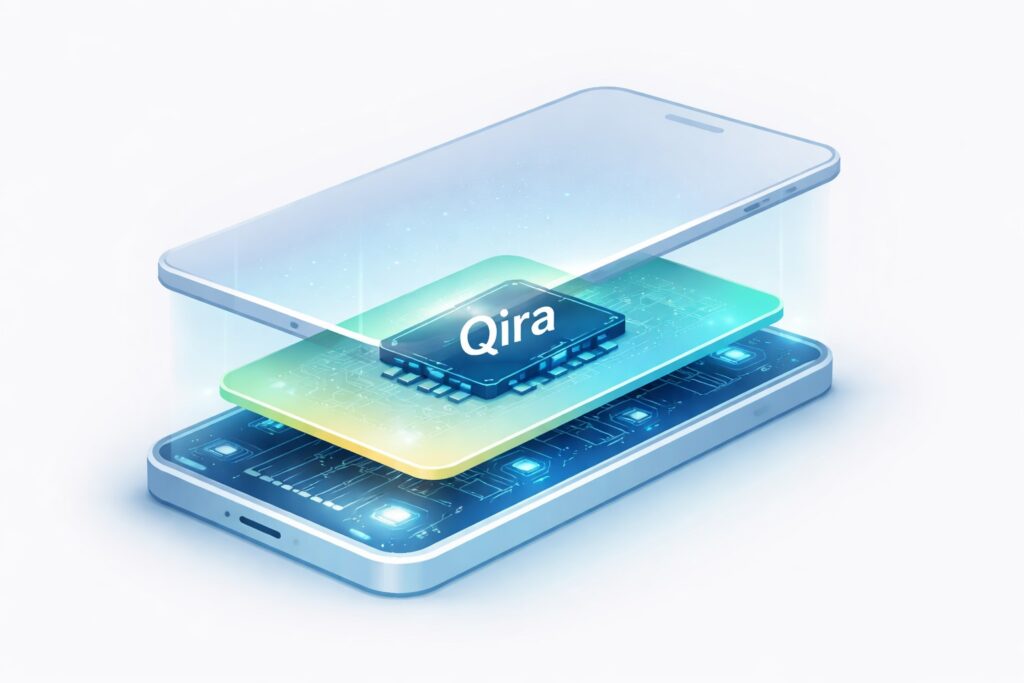
Central to this strategy is the unveiling of Qira, a personal AI platform designed to operate seamlessly across Lenovo and Motorola devices. Unlike traditional conversational assistants, Qira is built on a deeply integrated system architecture, offering persistent contextual awareness and a hybrid processing model that combines local computing with cloud services.
Rather than serving as a mere communication layer with cloud-based AI, this embedded system-level AI provides a consistent presence within the software architecture. It interacts with components such as task scheduling, energy management, permissions, local data flows, and hardware dedicated to inference. This fundamentally alters the nature of embedded AI, transforming it from a simple application layer into a core architectural element.
Qira: A Systemic and Multi-Device AI
Marketed as a “personalized, perceptive, and proactive” AI, Qira is positioned to assist users seamlessly as they transition between devices, whether they are using a PC, smartphone, or potentially, future hardware formats. Lenovo emphasizes that Qira leverages contextual usage, user preferences, and local history to suggest actions or recommendations, minimizing the need for explicit prompts.
This approach diverges from typical assistants that reside within individual applications. Qira functions as a transversal layer, integrated with the system and data flows of devices, prioritizing local processing to enhance responsiveness and safeguard user data. Lenovo asserts that this architecture enables advanced personalization while ensuring data privacy.
Comprehensive Refresh of PC and Mobile Offerings
Concurrently with the Qira announcement, Lenovo revealed plans for a significant renewal of its consumer and professional product lines. The ThinkPad, Yoga, IdeaPad, and ThinkCentre ranges will feature new configurations labeled as “AI PCs,” which utilize processors equipped for local inference along with software optimizations aimed at boosting productivity, collaboration, and energy management.
On the mobile front, Lenovo’s subsidiary Motorola introduced new devices that natively incorporate Qira. The company emphasizes a consistent user experience across PCs and smartphones, facilitated by a proprietary ecosystem that does not solely rely on AI offerings from major software platforms.
As is customary at CES, Lenovo also showcased several concepts aimed at exploring new hardware formats and innovative interactions. Expandable screens, eyewear with contextual assistance functions, and personal AI stations highlight the company’s vision for future technology, serving more as demonstrations than immediate product announcements. This approach allows Lenovo to use CES as a platform for testing the acceptability of emerging use cases and to inform its future industrial roadmaps.
An AI Strategy Beyond the Consumer Market
While CES announcements primarily highlight consumer applications, Lenovo envisions Qira and its AI portfolio as part of a broader strategy that also encompasses professional environments. The company underscores its capability to address AI across the entire spectrum, from endpoints to infrastructure, connected to its server and edge offerings designed for inference.
This integration between user endpoints and infrastructure creates a competitive edge against rivals focused more on software or cloud solutions, positioning Lenovo as a provider of complete architectures capable of supporting distributed AI applications from endpoint to enterprise.
With its announcements at CES 2026, Lenovo aims not just to create a dramatic disruption, but to establish AI as a foundational component of its platforms. This strategic direction seeks to enhance the value of its hardware ecosystem in a market where the commodification of AI models necessitates differentiation through integration, continuity of use, and architectural mastery.



