

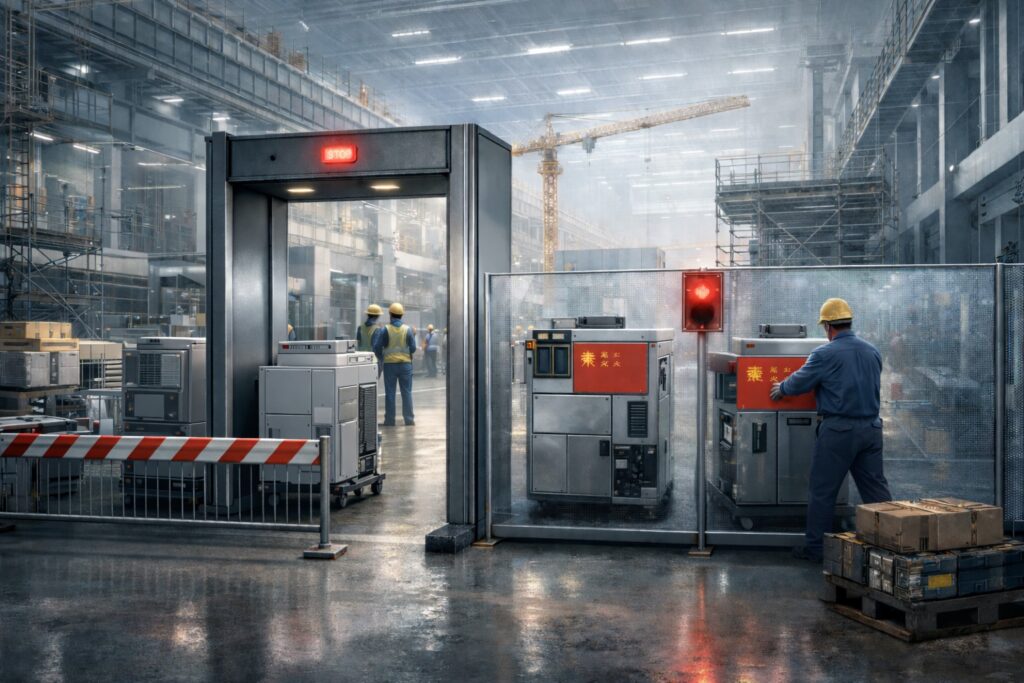
China Imposes Strict Domestic Equipment Rule for Semiconductor Production
China is intensifying its industrial policy in the semiconductor sector by mandating that 50% of all new production capacity be sourced from domestic equipment. This measure, which is enforced administratively yet lacks formal publication, underscores the protectionist stance Beijing has adopted following stricter U.S. export controls. The rule fundamentally shifts the balance of power in the global chip manufacturing equipment market.
Technological sovereignty has emerged as a cornerstone of China’s industrial strategy. Over the past two years, U.S. export restrictions on advanced technologies have accelerated China’s efforts to reduce its reliance on foreign suppliers. In the semiconductor industry, this strategy has reached a new level, requiring foundries to utilize a majority of domestically produced equipment for any expansion or new facility construction.
Multiple industry sources indicate that Chinese authorities now require applications for validating new production capacities to show that at least 50% of the manufacturing equipment is sourced from local suppliers. Projects falling short of this benchmark are typically excluded from public or semi-public tenders. However, exceptions remain for certain advanced technologies when local capabilities do not meet performance standards.
50%: A Midway Point
This new regulation is a continuation of a clear political trajectory. The central government is explicitly promoting a nationwide industrial mobilization aimed at establishing a semiconductor value chain capable of eventually operating without foreign dependence. The 50% threshold is seen as a preliminary target, with some officials already discussing a final goal of complete autonomy regarding critical equipment.
Industrially, this policy shift directly benefits Chinese semiconductor equipment manufacturers. Companies like Naura Technology and AMEC are witnessing increased order volumes, driven by the prioritization of local solutions. For instance, Naura has begun testing its etching tools on advanced lines at SMIC, including development efforts for nodes around seven nanometers, following successful deployments at fourteen nanometers.
This trend is mechanically altering the position of foreign suppliers—American, Japanese, and Korean—who historically relied on the Chinese market for a significant portion of their revenue. Even as their equipment may remain technically superior, their access to the Chinese market is becoming conditional and less predictable. In the medium term, this shift could negatively impact their revenues while pushing them to redirect their commercial efforts towards other regions or into advanced segments still out of reach for local solutions.
Reducing Exposure to Extraterritorial Decisions
Beyond the implications for China, this decision appears to be a direct response to U.S. export control policies enacted since 2022. Washington’s restrictions on advanced lithography equipment, etching tools, and certain critical components, alongside prohibitions on American suppliers from assisting China’s most advanced production capabilities, have compelled Beijing to rethink its industrial strategy. By conditioning access to new capacities on the use of domestic equipment, Chinese authorities aim to mitigate their exposure to extraterritorial decisions and secure their production chains.
For industry players, this evolution indicates a clearer fragmentation of global supply chains. Equipment manufacturers and foundries must now navigate divergent regulatory requirements across different regions, complicating investment planning, elongating decision-making cycles, and heightening geopolitical risks. In the medium term, this trend towards distinct technological blocs could permanently undermine the economies of scale and fluidity that have characterized the global semiconductor industry to date.



