

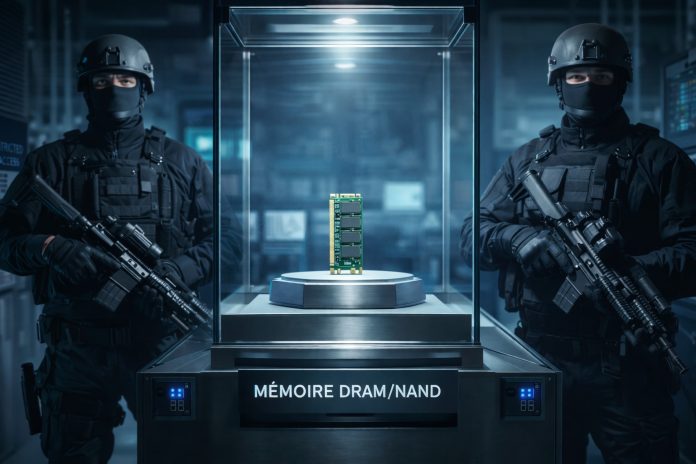
The global memory market is entering a critical phase. According to IDC, a massive reallocation of industrial capabilities towards memory for artificial intelligence computing is leading to a sustained shortage of DRAM and NAND intended for PCs and smartphones. This strain is expected to impact prices, delivery volumes in 2026, and manufacturers’ product strategies.
The supply chain challenges facing the memory sector extend beyond a mere industrial cycle. The three major global manufacturers – Samsung Electronics, SK Hynix, and Micron Technology – have prioritized the production of high-value technologies such as high-bandwidth memory (HBM) and high-capacity DDR5 modules, which are essential for AI infrastructures. This industrial shift significantly reduces the available supply for more traditional segments like personal computers and smartphones and increases the cost of components. IDC reports that memory supply growth is falling below historical standards as AI demand continues to rise. This situation is creating a structural imbalance that is expected to persist for several quarters.
The economic repercussions are already evident. PC prices are rising noticeably, with projections indicating increases ranging from a few percentage points to nearly twenty percent, depending on configurations and markets. Global PC shipment forecasts for 2026 have been downgraded, with contraction scenarios approaching ten percent in the most unfavorable cases. For smartphones, memory constitutes a significant portion of manufacturing costs, and the rapid price increases are disrupting existing balances. IDC anticipates a potential decline in global smartphone shipments in 2026, while some manufacturers are adjusting their entry-level and mid-range models or even delaying certain launches.
Prioritizing HBM, while DRAM and NAND are under pressure
The current industrial logic entails a clear trade-off. Production lines are focusing on the most profitable and sought-after memory types for data centers and AI infrastructure manufacturers. HBM, which has become strategic for AI accelerators and compute-intensive tasks, is absorbing an increasing share of capacity. This prioritization comes at the expense of standard DRAM and NAND meant for consumer markets. The additional capacities planned are insufficient to immediately compensate for this shift in priorities, especially considering the heavy and time-consuming investments required.
The direct consequence of this scenario is a scarcity of available volumes for consumer electronics, coupled with persistent inflationary pressure. Manufacturers are being forced to reconsider their product line compositions, to make tough decisions between maintaining margins and adjusting selling prices, and to rethink their replacement schedules. The so-called “AI PCs,” which require more memory, paradoxically intensify this tension by pushing manufacturers to increase capacity while relying on a resource that has become both strategic and constrained.
Asymmetrical effects among manufacturers
Not all brands are experiencing this crisis equally. Companies with high volumes and secured procurement agreements spanning multiple quarters, like Apple and Samsung, are better insulated against the shock. They manage long-term contracts and leverage their financial and industrial strength to absorb steeper price increases. Conversely, manufacturers operating in low-margin segments and emerging markets are facing much more direct pressures. They must choose between reducing memory configurations, passing the costs onto consumers, or accepting margin erosion.
This asymmetry could lead to lasting changes in the competitive landscape. Entry-level and mid-range segments are likely to slow down, while premium players consolidate their positions due to their ability to secure supply. In price-sensitive countries, rising costs could prolong replacement cycles, hinder the modernization of installed bases, and delay access to devices with better memory configurations.
Disrupted purchasing strategies
For customers, this shortage extends beyond merely technological concerns. It directly impacts investment planning, purchasing strategies, and the management of equipment renewal cycles. The rising memory costs are influencing the final prices of PCs and mobile devices, which in turn affects IT budgets. Procurement managers, CIOs, and integrators must secure their supply chains, negotiate longer commitments, diversify their sourcing strategies, and reassess replacement schedules to avoid a disconnect between costs and operational needs.
The current situation suggests a tighter market in 2026, where industrial trade-offs will increasingly favor AI-oriented memory. For economic players, vigilance is becoming key. Understanding production dynamics, monitoring price signals, and anticipating tensions will become critical to budgetary and operational resilience. Memory is no longer a mundane component; it has returned to being a vital factor for industrial competitiveness and a key indicator of the evolution of digital markets.



