

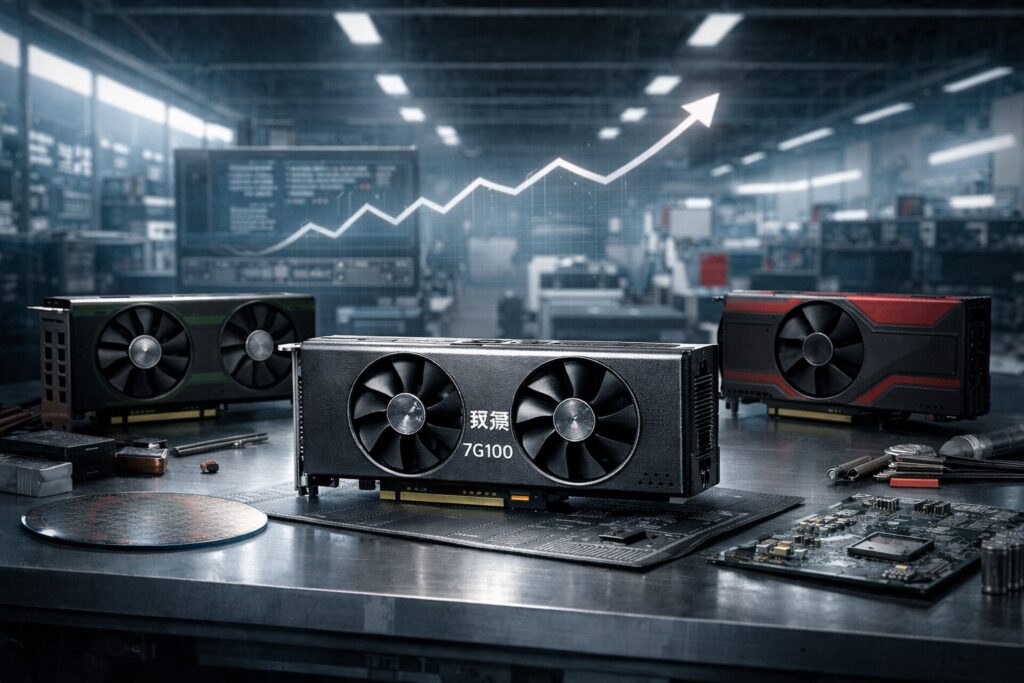
China’s Lisuan Technology Launches 7G100 GPUs, Marking a Milestone in National Competitiveness
With the launch of its first commercial deliveries of the 7G100 GPUs, Lisuan Technology is turning a long-held aspiration into reality — establishing a national supplier capable of producing modern graphics processors. This advancement marks a new chapter in the global GPU competition, focusing on industrial autonomy, supply chain security, and the emergence of alternatives to the NVIDIA–AMD duopoly.
In recent years, China has ramped up initiatives to reduce its reliance on critical components. Graphics processors, often seen as one of the most complex technologies to master, have historically remained a strategic blind spot. Therefore, Lisuan Technology’s announcement, founded in 2021 in Shanghai, carries both symbolic and industrial significance. The 7G100 GPUs, manufactured using a six-nanometer process and built on a proprietary architecture known as TrueGPU, are no longer mere prototypes — they are set to reach customers.
Initial delivery reports indicate a focus on professional applications, particularly in environments requiring computational graphics and simulation, such as digital twins and specific rendering applications. Technical media outlets have noted that industrial-scale production began in the autumn of 2025, with broader availability for consumers expected in 2026.
Promising but Dependent on Software Ecosystem
The 7G100 series features two distinct models. The 7G106, aimed at the consumer and gaming market, comes equipped with 12 gigabytes of GDDR6 memory, while the 7G105, designed for professional workloads, offers 24 gigabytes of memory with error correction support. Both utilize a six-nanometer manufacturing process from TSMC. Reports from several tech publications, including Wccftech and Notebookcheck, indicate that these chips have achieved over 111,000 points in OpenCL synthetic benchmarks, positioning them at a performance level comparable to that of the GeForce RTX 4060. Demonstrations also showcase demanding titles like Black Myth: Wukong running in 4K at viable settings, highlighting the genuine potential of these GPUs beyond mere theoretical claims.
However, while the advancements are undeniable, the path ahead for this new market entrant is fraught with challenges. Industry analysts point out that raw hardware power alone is insufficient; the maturity of drivers, long-term stability, compatibility with modern graphics APIs, and quality optimization are crucial to delivering a worthwhile experience. Lisuan’s GPUs will need to prove their reliability in real-world scenarios, from computational tasks to 3D production and gaming.
Another nuance complicates the notion of complete autonomy. Despite their Chinese design, the chips are manufactured by TSMC, which leaves technological sovereignty somewhat partial, especially amid ongoing geopolitical tensions. Nonetheless, this milestone is significant, as it marks the first time a Chinese company has delivered a modern original GPU at an industrial scale, capable of competing with established mid-range benchmarks.
A Strategic Signal to the Global Market
For the domestic market, Lisuan Technology provides a critical alternative in a segment vital for computing. This could lead to diversified supply sources, reduced exposure to international restrictions, and potentially improved alignment with local needs across industrial, scientific, educational, and defense applications. China is not merely looking to produce an equivalent but is progressively structuring a domestic GPU ecosystem capable of evolving.
For international enterprises, this development is noteworthy as well. The landscape of global GPU competition is expanding, and the presence of an additional player able to move toward export-ready offerings could alter competitive dynamics, accelerate innovation, and introduce a more pronounced geopolitical dimension to equipment choices. The first delivery of the 7G100 represents more than just a technological milestone; it serves as a pivotal marker in the ongoing industrial transformation of graphics computing.



