

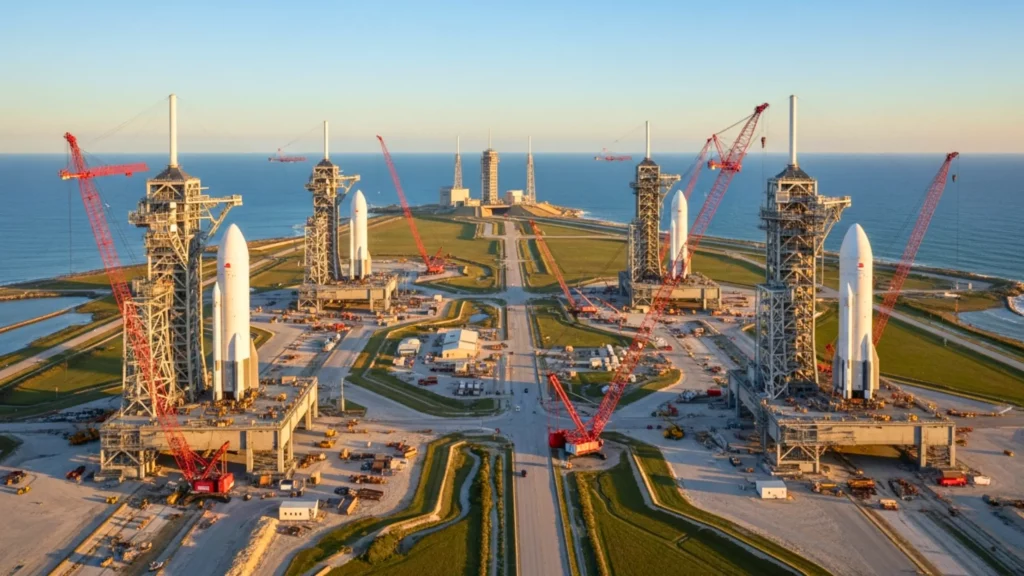
Florida becomes the nerve center of Elon Musk’s grand space maneuvers. SpaceX has received the green light to equip Cape Canaveral with three launch pads dedicated to the Starship. This strategic deployment paves the way for launches to the Moon, Mars… or any interstellar destination.
Two new launch pads for Starship at SLC-37: A forgotten site revived by SpaceX
The legendary LC-39A site, which once launched the Apollo missions, is well known. Now, it’s the turn of the SLC-37 complex, a more discreet location, to be revitalized under SpaceX’s initiative. The company led by Elon Musk announced in early December 2025 that it received the official approval to develop SLC-37A and SLC-37B zones at Cape Canaveral.
Interestingly, SLC-37A had never hosted a single rocket launch. SLC-37B has been dormant since the retirement of the Delta IV Heavy in 2024. Thus, SpaceX sees it as an ideal playground to build brand new infrastructure for Starship. Construction has already begun, with the clear goal of increasing launch cadence while ensuring better logistical resilience.
This choice also highlights SpaceX’s ability to recycle and repurpose existing facilities. Instead of starting from scratch, the company is reviving dormant sites and launching them into a new era. In a way, this represents a form of spatial industrial ecology.
Why SpaceX needs multiple launch pads to support Artemis, national security, and Mars
With two brand new launch pads at SLC-37 and another already operational at LC-39A, SpaceX is establishing a robust triad to launch its massive spacecraft. The reasoning behind this is redundancy. By increasing the number of launch sites, SpaceX reduces the risk of interruptions due to technical issues at any single one of them.
Moreover, these new facilities align with an ultra-ambitious timetable. The Starship is a central component of NASA’s Artemis program, aimed at returning humans to the Moon in the coming years. It could also serve for high-frequency military or commercial missions. For this, the capability to launch frequently and without delays is essential.
LC-39A: The legendary launch pad of Apollo missions becomes SpaceX’s showcase for the future
The LC-39A is not just a launch pad; it’s a historical monument. This is where the Saturn V rockets launched, along with the space shuttles. Today, SpaceX regularly conducts launches of its Falcon 9 and Falcon Heavy from this site. The company has also started adapting the infrastructure for Starship.
The integration of these two generations of rockets is a small engineering feat. It clearly demonstrates SpaceX’s commitment to build on its heritage while forging its future. In a few years, it would not be surprising to see multiple generations of launch vehicles coexisting at this launch pad, perfectly synchronized in a well-choreographed celestial ballet.
Symbolically, this is a strong gesture: to bring together the glorious past of lunar exploration and contemporary Martian ambitions. A seamless transition between two eras, with the Starship as the connecting link.
A gridlocked Cape Canaveral for faster, more frequent, uninterrupted launches
Including the LC-40, dedicated to Falcon 9, SpaceX could soon be launching rockets from four sites in Florida. This unprecedented logistical flexibility could leave competitors in the dust. The goal is clear: to launch often, quickly, and with multiple options.
This encapsulates Elon Musk’s strategy: not to depend on a single site, but to create a genuine spatial ecosystem at Cape Canaveral. Between redundant infrastructures, lunar ambitions, and a showcase of technological prowess, the Starship is transforming into more than just a spacecraft: it is the flagship of a space revolution.



