

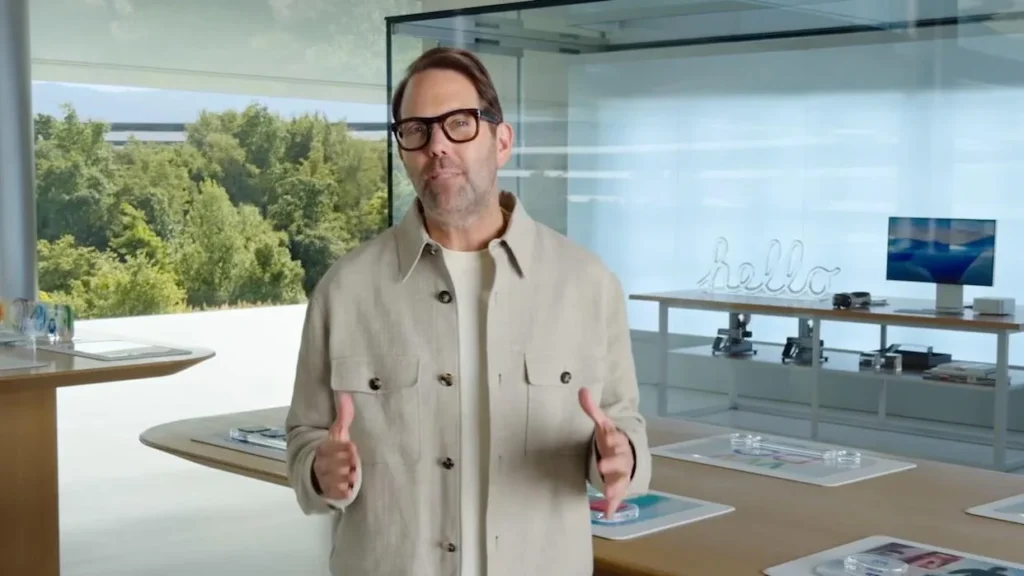
Alan Dye leaves Apple for Meta: a silent earthquake in Silicon Valley
Meta is launching a creative studio dedicated to the AI era — and has recruited one of the most influential architects of modern interface design. Some departures go unnoticed — while others redefine the power dynamics in Silicon Valley.
The exit of Alan Dye, head of interface design at Apple since 2015, clearly falls into the latter category.
This news, reported by Bloomberg, has sent shockwaves through the tech ecosystem: Alan Dye is joining Meta, where he will become chief design officer on December 31, with an ambitious mandate — to shape the next generation of hardware, software, and AI experiences.
For Apple, this is a strong symbolic moment. For Meta, it’s a strategic hire. For the design industry, it marks a pivotal moment.
Alan Dye: The Man Behind Apple’s Software Aesthetic Over the Last Decade
Alan Dye is a well-known figure: for the past 10 years, he has shaped the visual DNA of Apple’s interfaces. iOS, macOS, watchOS, visionOS — the transitions to flat design, the evolution of visual language, the coherence between hardware and software: Dye was one of the key architects.
His departure is part of a series of changes at the top in Cupertino: Jeff Williams (former COO) has retired, John Giannandrea (AI) is preparing to leave the company, Johnny Srouji (chips) is “evaluating his future,” and now, interface design will fall directly under Tim Cook’s responsibility.
Alan Dye will be replaced by Steve Lemay, a longtime Apple figure who has been with the company since 1999. Tim Cook praised him as an “exceptional talent” and a pillar of Apple’s creative culture.
Meta Recruits a Heavyweight — and Creates a Studio Echoing Apple
At Meta, Alan Dye isn’t coming alone. Mark Zuckerberg aims to turn this recruitment into a creative turning point. Meta is also announcing the opening of a new design studio, positioned at the heart of Reality Labs. The pitch: a space where design, fashion, and technology merge to reinvent smart objects.
Zuckerberg is straightforward: “Intelligence is becoming a new design material. We want to envision what becomes possible when it is abundant, capable, and human-centered.”
Alan Dye will now oversee software interfaces, embedded AI experiences, AR/VR product design (including future Meta Ray-Bans), and hardware-software integration — an area where Apple has always excelled.
A model very similar to Apple’s historical structure — but applied to the future of smart glasses and spatial computing.
Meta Assembles a “Dream Team” of Apple Defectors
Zuckerberg confirms that he hasn’t just recruited one name: Billy Sorrentino, an Apple designer, is also joining this new studio. Likewise, Joshua To, Pete Bristol (industrial design), and Jason Rubin (metaverse design) are on board.
This forms a true “elite unit” of design to accelerate Meta’s transition into a hardware/AI company, beyond just a social network.
Why Is Meta Focusing on Design Now?
Because the company is reaching a strategic turning point: AI-connected glasses and AR will shape Meta’s future. Zuckerberg’s headquarters no longer wants to just improve what exists — they want to rethink the relationship between humans, objects, and artificial intelligence.
The message is clear: AI is no longer merely a functional driver — it is an aesthetic material, a raw material of design. And for that, Meta wants the best.
A Talent Drain at Apple That Is Starting to Raise Concerns
The departure of Alan Dye occurs in a delicate internal context: design has been orphaned since Jony Ive left in 2019, several key figures have moved to LoveFrom, Tesla, or Google, the team is now directly under Tim Cook’s oversight, and Apple is undergoing a strategic transition towards AI products and spatial computing.
Apple retains an unparalleled expertise in industrial design, but early 2026 appears increasingly to signal the end of a cycle for its historical design teams.
A Masterstroke for Meta, an Alarm Bell for Apple
Alan Dye’s arrival at Meta is not just a talent transfer — it is a symbolic gesture. A sign that Meta now wants to compete in the realm of design with those who have made it a religion: Apple.
And perhaps it’s the clearest admission that to succeed in the era of AI glasses and immersive interfaces, more than just good algorithms will be needed.
It will require taste, sensibility, and a vision for design that Zuckerberg seems finally determined to elevate to a strategic priority.



