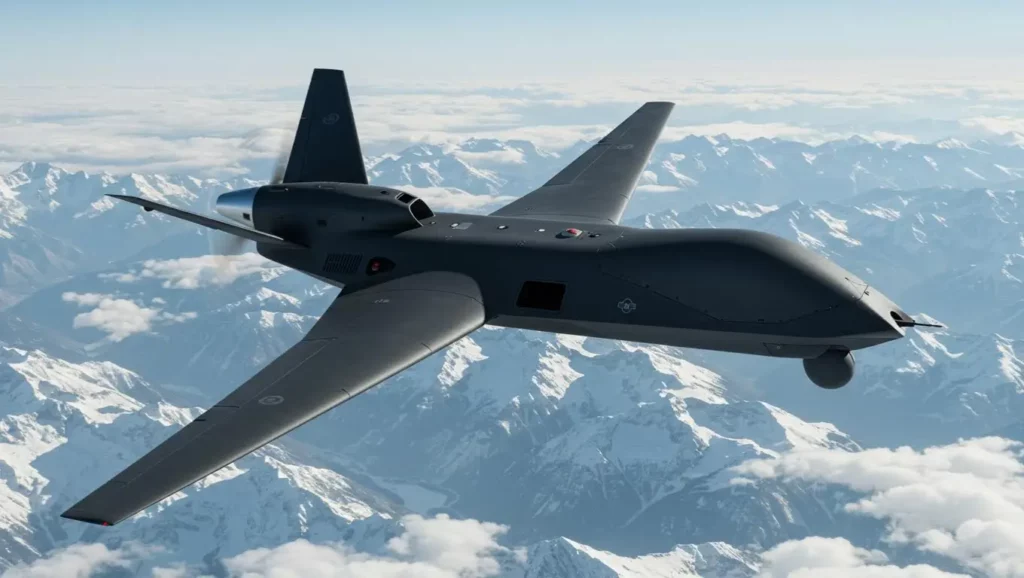
The image is striking: a country at war that, rather than just enduring, innovates to defend itself. Ukraine, under bombardment, is manufacturing its own combat drones, and some experts believe that these now surpass iconic Chinese models like the DJI Mavic. The goal is clear: to achieve technological independence while responding to the demands on the ground.
Ukraine designs and delivers its own military drones, freeing its army from Chinese dependence
For months, Ukrainian forces have been using Mavic quadcopters for reconnaissance, fire guidance, and precision strikes. However, following the ban on the sale of these drones in both Russia and Ukraine, the country has shifted towards local production.
Vice Prime Minister Mykhailo Fedorov confirmed to Forbes that over 1,000 Ukrainian-designed drones have already been delivered to the troops. Among them are innovative models such as the Ukropter, the Yautja, and the Shmavik, directly referencing the Chinese Mavic that they aim to surpass.
Their promise? Drones that are more robust, more autonomous, and better adapted to modern electronic warfare. This represents a true industrial revolution under extreme constraints and, crucially, a technological paradigm shift.
Ukrainian drones resist jamming and achieve five times more missions than a Mavic

At first glance, these Ukrainian drones appear bulkier and more expensive than their Chinese counterparts. However, the bet lies elsewhere. The Zoom model, developed by Frontline Robotics, is designed to operate in areas saturated with electronic jamming.
Equipped with a visual navigation system using artificial intelligence, it can continue its mission even without GPS or radio connectivity. As a last resort, it returns to its base using its visual sensors. This capability is crucial, especially on a front where Russian jammers are proliferating.
The figures are telling: 300 missions per drone, compared to an average of 60 for a Mavic. Thanks to this efficiency, the cost per mission is five times lower. This enhanced effectiveness more than compensates for a higher purchase price.
Ukraine develops a national drone industry, supported by allied technologies
Ukraine is not merely improvising. It is industrializing its production chain, despite the ongoing war. Although some components still come from China, the trend is toward greater autonomy: engines, batteries, thermal cameras, flight controllers… Everything is beginning to be designed and assembled locally.
Moreover, European partners are contributing to this effort. The Latvian company Atlas Aerospace provides a ground control station, the AtlasUltra, featuring a 2,000 nit brightness display. For comparison, DJI remote controllers max out at 700 nits. This seemingly technical detail makes all the difference in operations on a battlefield exposed to sunlight.
Some soldiers still miss the simplicity of DJI. But gradually, Ukrainian models are winning their trust, driven first by necessity and later by performance.
“For us, the key criterion is not the price per drone, but the cost per mission. While a classic Mavic performs about 60 missions per drone, our systems average 300. At comparable purchase prices, the cost per mission is five times lower, which means that the military units using our drones benefit from overall better economics,” explains a spokesperson for Frontline Robotics to Forbes.
The Ukrainian drone becomes a symbol of resilience and a strategic asset for modern warfare
For Kyiv, this is not just a logistical matter. It is a symbolic and strategic weapon. Developing high-performance drones means regaining control over its defense capabilities. It also means breaking free from reliance on foreign components and proving that a country under pressure can still innovate.
The Shmaviks and other Ukropters are not mere flying gadgets. They embody the technological resilience of Ukraine. Each successful mission, each return to base despite interference, and each hour gained on the enemy prove one thing: the sky of tomorrow could very well belong to Ukraine.