They walk in the rain, smile at customers, and fold laundry better than I do on a Sunday evening. In China, a new generation of humanoid robots is stepping out of tech showcases and into everyday life, with models capable of interacting, learning, and assisting humans in domestic or professional tasks.
The DR02 Of Deep Robotics: A Versatile Robot Ready To Leave The Lab And Face The Real World
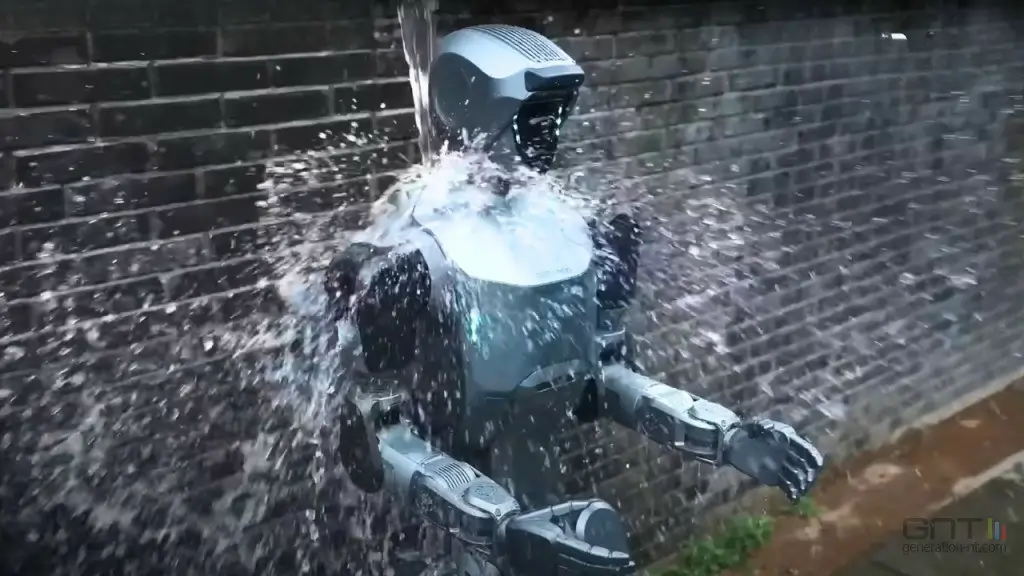
Let’s start with a striking example. Under a torrential downpour in Hangzhou, the DR02 stands firm. It measures 1.75 meters tall, walks at 4 m/s, carries 20 kg, and operates in temperatures ranging from -20 to +55 °C. This robot from Deep Robotics represents a significant turning point. We are moving from prototype to operational machine.
In other words, we transition from demonstrations to real-world applications. Sturdy, robust, and precise: it has all the makings of the perfect logistic or maintenance agent. Most importantly, it is IP66 certified. This proves that the equipment is designed for the field, not just for high-tech showcases. The ambition? To make the DR02 a daily tool for industries, somewhat akin to a 2.0 exoskeleton.
When Robots Become Sellers, Guides, And Multilingual Companions In Real Experiences
Let’s continue our overview with Wuhu. During the Chery 2025 conference, another humanoid took the spotlight: the Mornine from AiMOGA Robotics. It conducted an automotive sales demonstration entirely on its own. In eleven languages. Greeting customers, explaining models, and opening doors—all without a glitch.
Clearly, this feat is not only technical but also experiential. These robots are moving beyond booths. They are entering daily scenarios, and that changes everything. Once we see a robot fluently conversing in seven languages and handling fragile objects, we can’t help but wonder: “Why not in my home tomorrow?”
Accelerated Industrialization Of Chinese Robots Aims For Mass Deployment In Homes And Businesses
Meanwhile, another strong signal comes from the Canton Fair 2025, which reinforces the trend. Robots are for sale. More than 46 companies, 207,000 buyers, and 217 countries represented. Import contracts are already in the works. At Unitree Robotics, ambitions are high. The humanoid H2 folds clothes and navigates factories, capturing the interest of Alibaba, Tencent, and Geely.
At the same time, other players are making strides. AheadForm offers expressive faces. Kepler is promoting a Bumblebee robot priced at $34,000. In short, China is no longer just manufacturing robots for display. It is producing deliverable, testable, and improvable products in a rapid cycle.
China Prepares For A Society Where Humanoid Robots Will Be Ubiquitous By 2045
To delve deeper, one only needs to look at the numbers. 100 million robots by 2045. Not gadgets, but humanoids designed to work, assist, and sell. Beijing is investing 170 billion yuan. The goal? To integrate robotics everywhere: in factories, services, and homes.
In comparison, the United States is banking on AI with Tesla and its Optimus robot. China, on the other hand, is moving faster. It’s rapidly industrializing. Sensors, joints, embedded AI: everything is made locally. While others are still in the testing phase, China is deploying.
And where do we fit into all of this? On one hand, there is fascination; on the other, questioning. But one thing is certain: this revolution is unfolding before our eyes. It is no longer a matter of whether humanoids will arrive; it is about when and how they will transform our lives.