A message intended to celebrate a space mission has triggered a political earthquake. By unnecessarily flattering Donald Trump, NASA’s interim chief has sparked a storm on X. Elon Musk weighs in. The U.S. space strategy is heating up.
A Flattering Tweet Towards Trump Derails NASA’s Official Communication
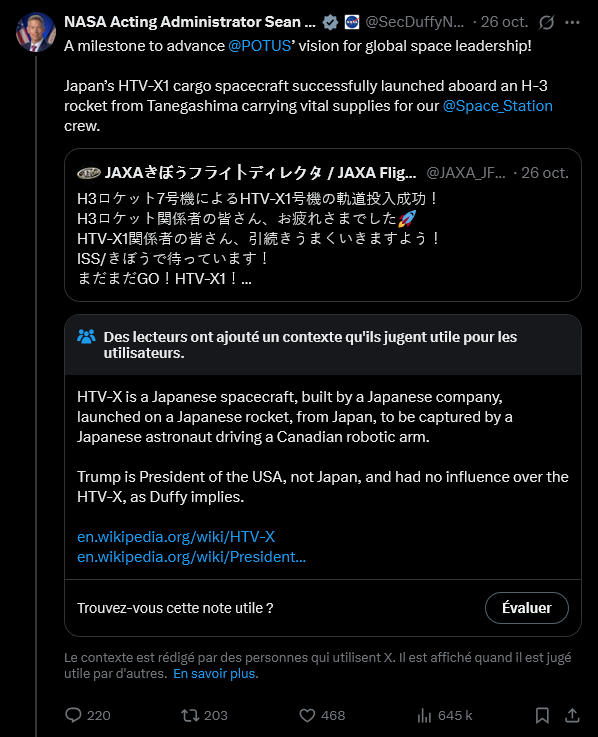
On October 26, 2025, JAXA successfully launched the HTV-X1, a Japanese cargo vehicle heading to the ISS. Up until then, all was well. However, Sean Duffy, the interim head of NASA, seized the opportunity to distinguish himself by paying tribute to Donald Trump. The issue? The United States has no connection to this mission.
He tweeted: “This is an important step forward in advancing the U.S. President’s vision of global leadership in space.” Yet, the spacecraft is Japanese, the rocket is Japanese, the launch site is in Japan, and the astronaut receiving the cargo is also Japanese. Moreover, the robotic arm used is Canadian.
As a result, the backlash was swift. The X community (formerly Twitter) erupted with mockery and outrage, and subsequently, a public correction note appeared under the tweet — a significant digital slap.
Elon Musk Enters the Arena and Targets Sean Duffy Personally
What could have remained a fleeting controversy gained momentum. Because Elon Musk jumped into the fray. It wasn’t just the tweet that prompted his reaction; it was also Duffy’s attitude toward SpaceX.
Since his appointment, Duffy has been questioning the lunar contract awarded to SpaceX, intending to reignite competition for the Artemis III mission. This decision threatens Musk and ignites his anger.
Thus, on X, Musk launches a series of attacks. He calls Duffy “Sean Dummy,” mocks his intelligence, and accuses him of attempting to sabotage NASA. Duffy quickly becomes the number one target on social media.
Public Opinion Divided but Growing More Favorable to Jared Isaacman
Amid these attacks, a key question arises: who should really lead NASA? Many are calling for the return of Jared Isaacman, an entrepreneur and space enthusiast. He was previously considered by Trump but was sidelined due to his ties with SpaceX.
This paradox is striking. To limit Musk’s influence, Trump appointed Duffy. However, Duffy lacks expertise in space, and his media blunders stand out. As a result, Isaacman emerges as a credible alternative — less political and more competent.
Furthermore, he appeals especially to space enthusiasts, those desiring a clear direction capable of addressing upcoming technical and geopolitical challenges.
The Underlying Issue Behind the Crisis: Who Dictates American Space Strategy?
In essence, this tweet reveals a deeper rift — the divide between public institutions and private interests. And behind these tensions lies a crucial question: Can NASA still chart its own course?
The incident with the HTV-X1 serves merely as a revelation. Tensions have been brewing for a long time: political pressures, technical delays, commercial rivalries. And at the center of all this: Elon Musk, ever-present.
In other words, space is no longer a neutral ground. It has become a battlefield where strategy, ego, and industrial ambitions converge. If NASA wants to maintain control over its destiny, it must quickly find a strong and independent leadership.